Beyond the GPU: Why Specialized AI Chips Like TPUs are Revolutionizing Performance
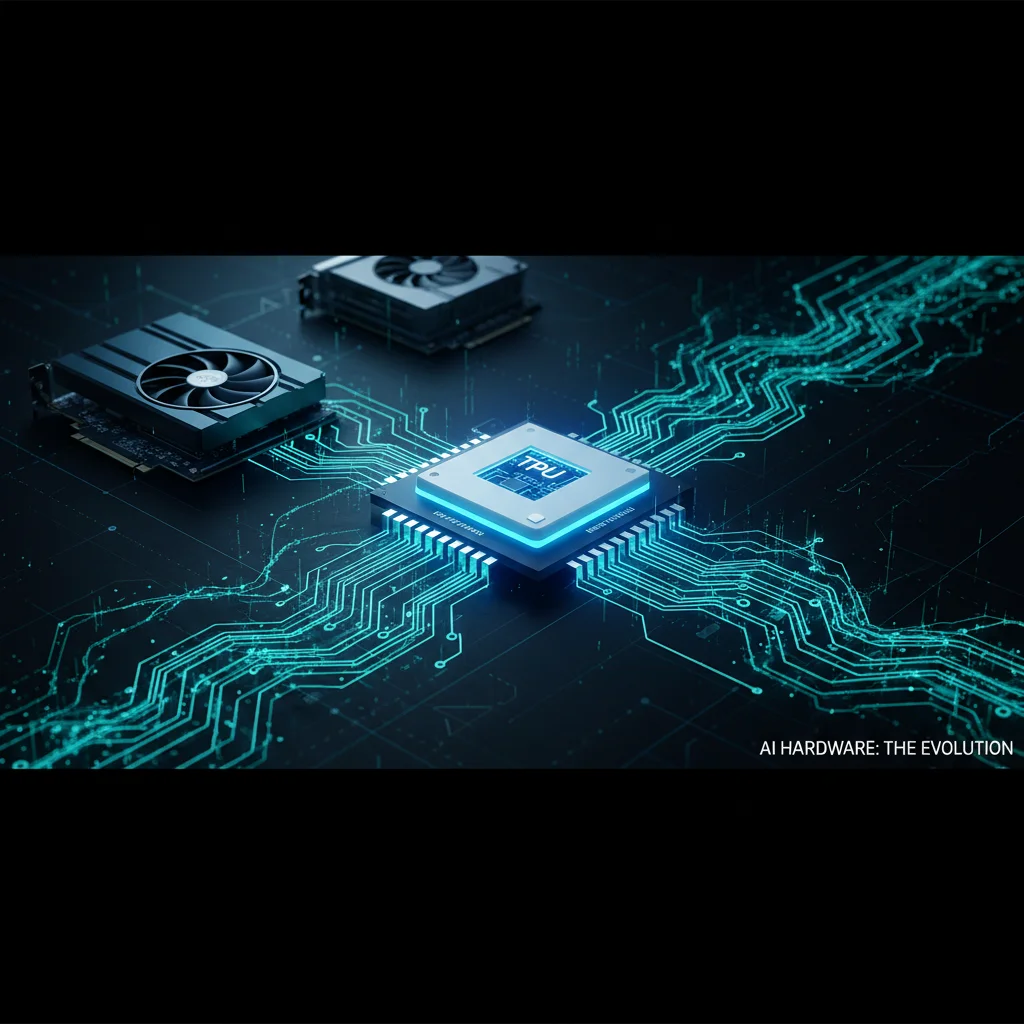
- GPUs face growing limits, inefficiency, and cost challenges for AI inference at scale.
- Specialized AI chips like TPUs offer superior performance per watt and lower latency for inference.
- Exploding generative AI demands real-time, low-latency processing, driving new hardware needs.
- New contenders like Groq and Cerebras are further revolutionizing the AI chip landscape.
- Optimizing AI infrastructure with specialized hardware is crucial for competitive advantage.
What You'll Learn
- The Shifting Sands of AI Hardware: Beyond the GPU
- The GPU Hegemony and Its Growing Limits
- Enter the Era of Specialized Chips: TPUs Lead the Charge
- The New Contenders: Groq, Cerebras, and the LPU Revolution
- Economic Shifts, Acquisitions, and the Future AI Hardware Landscape
- Frequently Asked Questions About AI Chips
The Shifting Sands of AI Hardware: Beyond the GPU
For years, the Graphics Processing Unit (GPU) has reigned supreme as the workhorse of artificial intelligence. Its parallel processing capabilities, originally designed for rendering complex graphics, proved serendipitous for the intensive mathematical computations required by machine learning models.
NVIDIA, with its powerful GPUs and the ubiquitous CUDA programming platform, established a near-monopoly, powering everything from cutting-edge AI research to the vast neural networks behind today's generative AI breakthroughs. However, the landscape is rapidly evolving, pushing the boundaries of what general-purpose hardware can achieve.
As AI models grow exponentially in size and complexity, especially with the explosion of generative AI, new bottlenecks are emerging. The demand for faster inference – the process of using a trained model to make predictions – at lower power consumption is driving innovation far beyond the traditional GPU.
This article dives deep into why specialized AI chips, such as Google's Tensor Processing Units (TPU) and innovative solutions from companies like Groq with its Language Processing Units (LPU), are not just catching up but, in many critical aspects, winning the race. We'll explore the economic drivers, technological advancements, and the strategic implications for the tech industry.
Understanding this hardware shift is crucial for any business leveraging AI. The digital marketing experts at Integradyn.ai recognize that optimizing your AI infrastructure, from pre-training to inference, directly impacts efficiency and competitive advantage.
The GPU Hegemony and Its Growing Limits
NVIDIA's dominance in the AI hardware space is undeniable. Their GPUs, particularly the A100 and H100 series, have become synonymous with high-performance computing for AI, driven by their massively parallel architectures.
The CUDA ecosystem further cemented this position, providing developers with a powerful, comprehensive toolkit to program GPUs, effectively creating a high barrier to entry for competitors. This combination allowed GPUs to accelerate the initial training phase of large AI models, a compute-intensive task that benefits immensely from parallel processing.
However, the very strengths that made GPUs ideal for training are becoming limitations for AI inference, especially at scale. Inference often involves different computational patterns, requiring high throughput and low latency for individual predictions rather than massive batch processing.
General-purpose GPUs, while flexible, carry overheads associated with their broader capabilities. This overhead can translate into higher power consumption, increased latency, and less efficient utilization for highly specific AI inference tasks.
The demand for real-time generative AI applications, such as chatbots and image generation, underscores these emerging challenges. These applications require instantaneous responses, making even milliseconds of latency a significant issue.
The cost associated with acquiring and operating high-end GPUs also presents a significant hurdle for many organizations. The economics of scaling AI inference become prohibitive when relying solely on general-purpose hardware.
This creates a clear incentive for specialized hardware designed to excel in these specific, high-volume inference scenarios. The limitations highlight a growing chasm between the needs of AI training and the distinct requirements of AI inference.
While GPUs remain essential for AI training, their general-purpose architecture introduces inefficiencies and cost challenges for the increasing demands of AI inference, paving the way for specialized accelerators.
AI Chip Roles: GPU vs. Specialized Accelerators
GPU: General Purpose Powerhouse
Strengths: Massively parallel, highly programmable, excellent for complex, diverse computations like AI model training. Strong ecosystem (CUDA).
Weaknesses: Higher power consumption, latency overhead for specific inference tasks, less cost-efficient at scale for pure inference.
TPU: Inference Specialist
Strengths: Designed specifically for matrix multiplication (core of neural networks), extremely efficient for AI inference, lower power, high throughput. Cloud-native integration.
Weaknesses: Less flexible for diverse workloads, not ideal for general-purpose computing or certain types of training.
LPU/WSE: Hyper-Specialized Innovators
Strengths: Ultra-low latency for specific models (LPU), massive on-chip memory/cores (WSE) for unprecedented scale. Pushing boundaries of parallel processing.
Weaknesses: Highly specialized, niche applications, complex software stacks, potentially higher upfront investment, less mature ecosystem.
Enter the Era of Specialized Chips: TPUs Lead the Charge
Google recognized the impending limits of GPUs for its internal AI workloads over a decade ago. Facing massive computational demands for services like Search, Translate, and Street View, they embarked on designing custom silicon: the Tensor Processing Unit (TPU).
The first generation of TPUs, released in 2016, focused entirely on accelerating AI inference. Their architecture was meticulously optimized for matrix multiplication, the fundamental operation in neural network computations, and featured fixed-point arithmetic for efficiency.
This narrow focus allowed TPUs to achieve significantly higher performance per watt and lower latency for specific AI tasks compared to contemporary GPUs. Google's cloud infrastructure became the primary deployment ground, providing a powerful advantage for their AI services.
Subsequent TPU generations, like v2, v3, and v4, expanded capabilities to include AI training, offering a more balanced approach while retaining their core inference strengths. These advancements underscore a strategic pivot towards custom silicon for crucial AI workloads.
The design philosophy behind TPUs centers on eliminating unnecessary general-purpose components, maximizing throughput for AI-specific operations, and tightly integrating hardware with software frameworks like TensorFlow and JAX. This co-design approach yields tremendous efficiencies.
"The GPU was the right answer for general purpose parallel computing, but for specific deep learning workloads, we could do much better. We stripped away the generality and focused on the core operations of neural networks."
Jeff Dean, Google Senior Fellow and Head of Google AIThe impact of TPUs extends beyond Google's internal operations. By offering TPUs through Google Cloud, they have democratized access to this specialized hardware, enabling startups and researchers to tackle ambitious AI projects without the immense capital expenditure of building custom data centers.
This accessibility fuels innovation and accelerates the adoption of advanced AI models. For businesses that rely heavily on large-scale AI inference, TPUs offer a compelling alternative to traditional GPU clusters.
When evaluating AI hardware, don't just look at peak FLOPS. Consider power efficiency, latency for your specific inference workload, and the overall ecosystem integration. For generative AI, latency is often paramount.
The strategic move by Google highlights a broader industry trend: the increasing vertical integration of hardware and software for AI. Companies are realizing that off-the-shelf components, while convenient, may not offer the optimal performance or cost-efficiency for their unique AI at scale.
This shift requires careful consideration of long-term infrastructure strategy. The team at Integradyn.ai understands that choosing the right infrastructure is crucial for businesses leveraging AI, especially when optimizing for speed and cost in modern digital landscapes.
Ready to Optimize Your AI Strategy?
Leverage cutting-edge insights to drive superior performance. Discover how specialized AI chips can transform your operations.
Schedule Your Free ConsultationThe New Contenders: Groq, Cerebras, and the LPU Revolution
While Google led the charge with TPUs, a new wave of startups and established players are pushing the boundaries of specialized AI hardware. These companies are developing innovative architectures designed to address specific pain points in the AI pipeline, often with radical approaches.
One of the most talked-about innovators is Groq, founded by Jonathan Ross, an engineer who helped develop Google's original TPU. Groq's flagship product is the Language Processing Unit (LPU), a chip engineered from the ground up for extremely low-latency inference on large language models (LLMs).
The LPU's architecture emphasizes a deterministic, instruction-driven approach, reducing the variability and overhead often found in traditional architectures. This allows for unparalleled predictability and speed, which is critical for real-time generative AI applications.
Groq's LPU demonstrates significant advantages in terms of tokens-per-second output and consistency, directly addressing the bottleneck of slow generative AI responses. This is a game-changer for applications requiring rapid, high-quality text generation.
Another formidable player is Cerebras Systems, which took a fundamentally different approach with its Wafer-Scale Engine (WSE). The WSE is the largest chip ever built, comprising trillions of transistors and hundreds of thousands of AI-optimized cores on a single silicon wafer.
Cerebras aims to eliminate traditional memory wall issues and communication latencies by keeping all processing and memory on a single, massive chip. This architecture is particularly well-suited for extremely large AI models and complex scientific simulations, tackling challenges that even GPU clusters struggle with.
While specialized hardware offers immense performance gains, companies must be wary of potential vendor lock-in. Ensure your long-term AI strategy accounts for hardware diversity and interoperability where possible.
Other companies, like Intel with its Gaudi accelerators, AMD with its Instinct series, and numerous startups developing custom ASICs (Application-Specific Integrated Circuits), are also vying for a share of the burgeoning AI chip market. Each offers unique strengths tailored to different aspects of the AI workload.
These specialized chips are characterized by several key design principles. They often feature large on-chip memory, customized arithmetic units for AI operations, and highly optimized data paths to minimize data movement bottlenecks.
Understanding the nuances of these different architectures is vital for making informed infrastructure decisions. Agencies like Integradyn.ai often see clients struggle with selecting the optimal hardware, highlighting the need for expert guidance in navigating this complex landscape.
Economic Shifts, Acquisitions, and the Future AI Hardware Landscape
The rise of specialized AI chips is not merely a technological evolution; it's a profound economic shift. The high costs associated with training and running large AI models on traditional GPUs are creating a powerful incentive for businesses to explore more efficient alternatives.
Optimizing AI economics means achieving more computational output per dollar and per watt. Specialized chips often deliver superior performance/cost ratios for their targeted workloads, leading to significant operational savings over time.
This economic pressure is driving investment into AI chip startups. Silicon Valley is buzzing with innovation, and major tech companies are keenly watching for acquisition targets that could bolster their AI capabilities and reduce reliance on external suppliers.
We've already seen companies like Microsoft invest heavily in custom silicon for their Azure cloud, and Amazon with its Inferentia and Trainium chips for AWS. This trend towards vertical integration is a direct response to the strategic importance of AI hardware.
The potential for monopolies, particularly if one company gains an insurmountable lead in a critical specialized chip market, raises anti-trust concerns. Regulators are likely to scrutinize future acquisitions and market dominance in this rapidly evolving sector.
The future of AI hardware will likely be heterogeneous, with a mix of GPUs, TPUs, LPUs, and other specialized ASICs coexisting. The optimal solution will depend on the specific AI workload, scale, and cost constraints of each application.
According to the SEO specialists at Integradyn.ai, understanding these shifts is vital for strategic planning, not just for tech giants but for any business seeking to leverage advanced AI effectively and maintain a competitive edge online.
The industry is moving towards a future where computational resources are precisely matched to task requirements. This fine-grained optimization will be key to unlocking the next generation of AI capabilities and making them economically viable for broader adoption.
Early adoption of these specialized architectures can provide a significant competitive advantage. Businesses that strategically deploy TPUs, LPUs, or other custom silicon for their generative AI or high-volume inference tasks will see gains in speed, efficiency, and cost.
The long-term vision involves even more sophisticated co-design, where AI models are developed with a specific hardware architecture in mind from the outset. This symbiotic relationship between software and hardware will push the boundaries of what AI can achieve.
For service businesses aiming to integrate AI, staying informed about these hardware trends is paramount. Integradyn.ai assists companies in navigating the complexities of AI adoption, ensuring their digital strategies are built on a robust and efficient technological foundation.
Ready to Future-Proof Your AI Investments?
Don't get left behind in the AI hardware race. Partner with experts who understand the evolving landscape.
Discover Our AI SolutionsFrequently Asked Questions About AI Chips
What is the primary difference between a GPU and a TPU?
A GPU (Graphics Processing Unit) is a general-purpose parallel processor excellent for various compute-intensive tasks, including AI training. A TPU (Tensor Processing Unit) is a specialized Application-Specific Integrated Circuit (ASIC) designed specifically to accelerate neural network operations, particularly matrix multiplications, making it highly efficient for AI inference and specific training workloads.
Why is AI inference performance becoming so critical?
As generative AI models and real-time AI applications proliferate, the speed at which these models can make predictions (inference) directly impacts user experience and application viability. Slow inference leads to frustrating delays in chatbots, image generation, and other interactive AI services.
What is CUDA and why is it important for NVIDIA's dominance?
CUDA is NVIDIA's parallel computing platform and programming model. It provides a software layer that allows developers to use NVIDIA GPUs for general-purpose processing. Its robust ecosystem and wide adoption have created a strong lock-in effect, making it challenging for competitors to gain traction.
What is Groq's LPU and how does it differ from a TPU?
Groq's LPU (Language Processing Unit) is another specialized AI chip, particularly optimized for extremely low-latency inference of large language models (LLMs). While TPUs are excellent for general neural network operations, LPUs focus on deterministic, high-speed execution for sequential token generation, crucial for real-time generative AI.
Are specialized AI chips only for large tech companies?
No, not anymore. While initially developed by tech giants like Google, many specialized chips are now available through cloud providers (like Google Cloud for TPUs) or as dedicated hardware from startups. This makes them accessible to a wider range of businesses and researchers.
What are the economic benefits of using specialized AI hardware?
Specialized AI hardware often offers superior performance per watt and per dollar for specific AI workloads. This translates to lower operational costs, reduced power consumption, and faster processing times, which can provide a significant competitive advantage for AI-driven services.
What is the 'memory wall' problem that Cerebras aims to solve?
The 'memory wall' refers to the bottleneck caused by the increasing speed gap between the CPU/GPU and main memory. Data movement between these components consumes significant time and energy. Cerebras' Wafer-Scale Engine aims to solve this by integrating massive amounts of memory directly onto the same chip as the processing cores.
Will GPUs become obsolete for AI?
It's unlikely GPUs will become obsolete entirely. They remain highly flexible and powerful for diverse AI training tasks and general-purpose parallel computing. However, their dominance in AI inference is being challenged, leading to a more heterogeneous hardware landscape where specialized chips pick up specific high-volume workloads.
What is 'vertical integration' in the context of AI chips?
Vertical integration in AI chips means a company designs and manufactures its own specialized silicon tailored to its specific software and cloud infrastructure needs. Examples include Google's TPUs, Amazon's Inferentia/Trainium, and Microsoft's custom AI accelerators. This reduces reliance on third-party suppliers and optimizes performance.
What are the anti-trust concerns in the AI chip industry?
As specialized AI chips become increasingly critical, there are concerns that dominant players or early innovators could gain an unfair market advantage. This could lead to monopolies or stifle competition, prompting regulatory bodies to monitor mergers, acquisitions, and market practices closely.
How can Integradyn.ai help businesses navigate this AI hardware landscape?
Integradyn.ai provides strategic consulting and digital marketing expertise, helping businesses understand the implications of these technological shifts for their AI deployments and overall online presence. We assist in identifying optimal AI infrastructure choices that align with business goals and budget.
What is the role of 'AI Pre-training' in relation to these chips?
AI Pre-training is the initial, highly compute-intensive phase where a large model learns general patterns from vast datasets. GPUs have historically excelled here. However, some specialized chips, like later generations of TPUs and Cerebras' WSE, are now also optimized for this demanding task, offering alternatives for massive scale training.
What is an ASIC in the context of AI?
ASIC stands for Application-Specific Integrated Circuit. It's a microchip designed for a particular application, rather than general-purpose use. TPUs and LPUs are examples of AI-specific ASICs, built from the ground up to accelerate AI computations, making them highly efficient but less flexible than GPUs.
How do 'AI Economics' factor into hardware decisions?
AI Economics refers to the cost-effectiveness and efficiency of deploying and operating AI systems. This includes factors like initial hardware cost, power consumption, cooling, maintenance, and the total cost of ownership. Specialized chips aim to improve AI economics by offering better performance-per-dollar and performance-per-watt for specific tasks.
What should a business consider when choosing AI hardware?
Businesses should consider their specific AI workloads (training vs. inference, model type), latency requirements, budget, scalability needs, vendor lock-in risks, and the availability of software ecosystem support. A strategic approach often involves a mix of hardware solutions.
What is the 'Future of AI' looking like with these chip advancements?
The future of AI will be characterized by increasingly powerful, efficient, and specialized AI models, enabling real-time, highly personalized, and embedded AI experiences. These chip advancements are fundamental to making such advanced AI economically viable and ubiquitous, pushing the boundaries of what's possible.
How important is 'Silicon Valley' in this AI chip evolution?
Silicon Valley remains a crucial hub for innovation in AI chips, attracting top engineering talent and venture capital. Many of the leading startups and established tech giants driving this specialized hardware revolution are based there, fostering a vibrant ecosystem of research, development, and commercialization.
What are 'Tech Industry Trends' indicating about AI hardware?
Current tech industry trends indicate a strong move towards specialization and vertical integration in AI hardware. Companies are investing heavily in custom silicon to gain competitive advantages, optimize for specific workloads, and manage rising compute costs associated with increasingly complex AI models.
How does 'Generative AI' specifically benefit from specialized chips?
Generative AI, especially large language models, benefits immensely from specialized chips like LPUs due to their need for extremely fast, low-latency inference. These chips can generate text, images, or other media much quicker and more consistently than general-purpose hardware, enhancing real-time interactive applications.
What is the role of Jonathan Ross in this specialized chip landscape?
Jonathan Ross is a significant figure, having been part of the original Google TPU team. He later founded Groq, pioneering the Language Processing Unit (LPU) with a focus on ultra-low-latency inference for large language models, making him a key innovator in the specialized AI chip space beyond Google.
Legal Disclaimer: This article was drafted with the assistance of AI technology and subsequently reviewed, edited, and fact-checked by human writers to ensure accuracy and quality. The information provided is for educational purposes and should not be considered professional advice. Readers are encouraged to consult with qualified professionals for specific guidance.