Revolutionize Robot Control: New AI Teleoperation Without the Gear
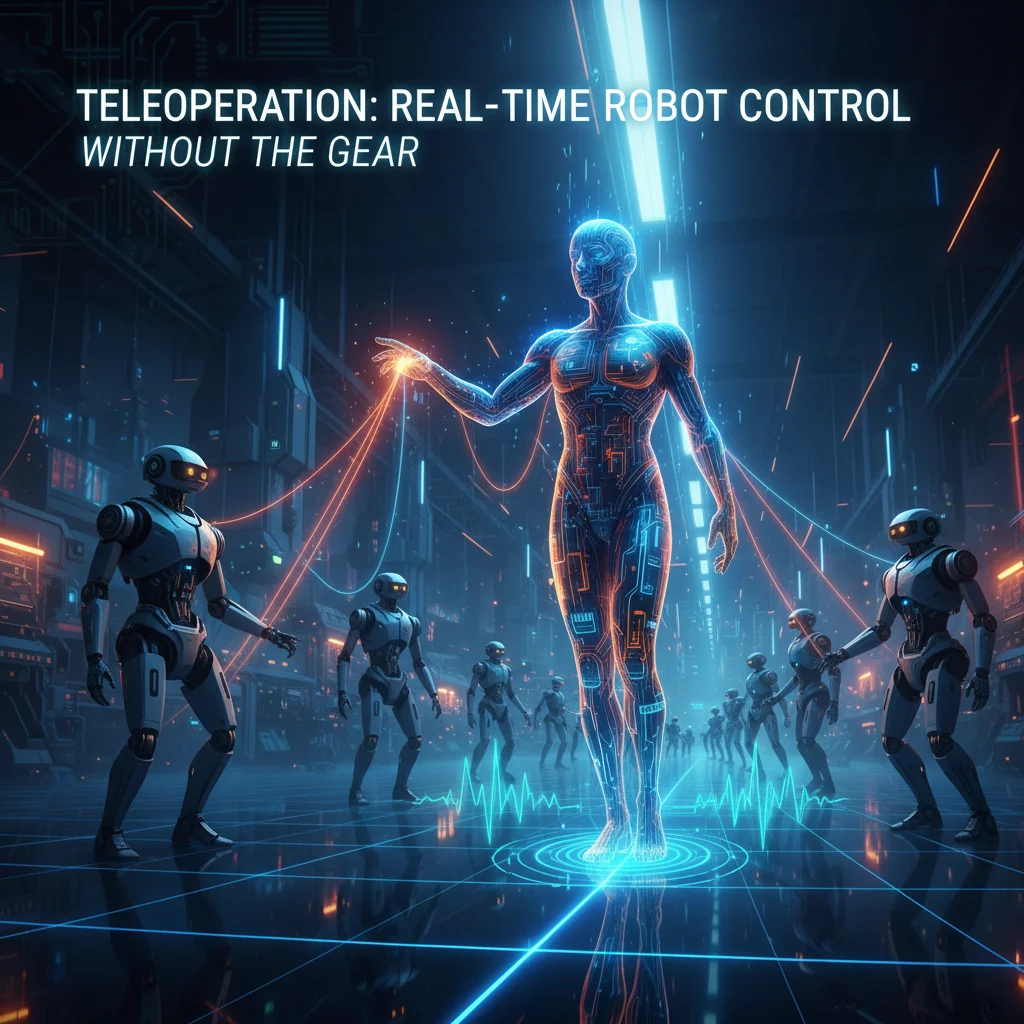
- New AI teleoperation revolutionizes robot control without physical gear.
- Generative AI, Computer Vision, and LLMs translate human intent to action.
- It significantly reduces training time, hardware costs, and boosts flexibility.
- Operators use natural language and gestures for intuitive, high-level control.
What You'll Learn
- A New Era of Robot Control: Beyond the Joystick
- The Paradigm Shift: From Physical Gear to Digital Intuition
- The AI Powerhouse: Technologies Behind Gearless Teleoperation
- Mastering the Interface: Implementation and Overcoming Challenges
- The Future Unveiled: Impact Across Industries and Beyond
- Frequently Asked Questions
A New Era of Robot Control: Beyond the Joystick
The landscape of robotics is undergoing a monumental transformation, challenging our long-held perceptions of how we interact with machines. For decades, teleoperation has been synonymous with clunky gear, complex interfaces, and a steep learning curve. Operators often required specialized hardware, from haptic feedback gloves to cumbersome VR headsets, to guide robots remotely.
This traditional approach, while effective, created significant barriers to entry and limited the agility and scalability of robotic deployments. Imagine controlling a robot in a hazardous environment, needing not just precision but also an intuitive connection that minimizes human strain and maximizes efficiency. The old ways were simply not cutting it for the demands of modern industry and exploration.
Today, we stand at the precipice of a new frontier: new teleoperation, a revolutionary approach that promises real-time robot control without the gear. This isn't just an incremental improvement; it's a fundamental reimagining, driven by the explosive advancements in Artificial Intelligence, particularly Generative AI and Large Language Models (LLMs).
This innovation transcends the need for physical controllers, leveraging advanced AI Tech Trends to create a seamless, intuitive bridge between human intent and robotic action. It opens up unprecedented possibilities for industries ranging from manufacturing and logistics to healthcare and deep-space exploration. The future of robotics is here, and it's remarkably gearless.
This comprehensive article will dive deep into the mechanisms, implications, and future potential of this groundbreaking technology. We will explore how cutting-edge AI Tools are making this possible, and what it means for businesses and individuals alike. Prepare to rethink everything you thought you knew about controlling robots.
The Paradigm Shift: From Physical Gear to Digital Intuition
Redefining Teleoperation with AI
Traditional teleoperation has always been a marvel of engineering, allowing humans to extend their presence into remote or dangerous environments. From bomb disposal units to surgical robots, the ability to control a machine from a distance has saved lives and enabled incredible feats. However, this control has historically come at a cost: specialized, often expensive, and physically demanding equipment.
The paradigm shift we are witnessing is fueled by an astonishing convergence of several key AI technologies. Generative AI, for instance, isn't just creating text or images; it's now generating complex control strategies and interpreting human commands in ways previously thought impossible. This is the core of real-time robot control without the need for bespoke physical gear.
Imagine a scenario where an operator uses natural language commands, perhaps combined with simple gestures captured by a standard webcam, to direct a robotic arm. The AI interprets these high-level instructions, translating them into precise motor movements, collision avoidance protocols, and task sequencing. This level of abstraction significantly lowers the barrier to entry for robot operation.
Computer Vision plays a crucial role here, allowing the robot and its AI controller to perceive the environment with unprecedented detail. It processes visual inputs, identifies objects, tracks movements, and builds a real-time understanding of the operational space. This visual intelligence is then fed into the decision-making processes of the Generative AI, enabling adaptive and responsive control.
New teleoperation leverages Generative AI and Computer Vision to translate high-level human intent into precise robotic actions, eliminating the need for specialized physical control gear.
The Evolution of Control Interfaces
Historically, teleoperation interfaces were a complex array of buttons, joysticks, and sometimes even full-body exoskeletons designed for specific robotic systems. These interfaces required extensive training and offered limited flexibility, often locking users into proprietary ecosystems.
The advent of sophisticated Neural Networks and Deep Learning algorithms has fundamentally changed this. These AI models can learn complex relationships between human input (whether it's voice, gaze, or simple hand movements) and desired robot behaviors. This learning process is continuous, allowing the system to adapt and improve over time, making it more intuitive with each interaction.
Consider the analogy of autonomous driving: while not direct teleoperation, it relies on AI to interpret the environment and make driving decisions. In new teleoperation, the human provides the high-level intent, and the AI acts as the intelligent co-pilot, handling the low-level execution details. This symbiotic relationship vastly enhances both control and safety.
The shift to gearless control also means greater accessibility. A broader range of individuals, including those without specialized training, can now potentially operate complex machinery. This democratization of robot control has profound implications for workforce development and the adoption of automation across various sectors.
This revolution is not just about convenience; it's about unlocking new efficiencies and capabilities that were previously unattainable. The reduced cost, improved flexibility, and enhanced accessibility are driving a rapid adoption curve in industries ready for the Future of Tech.
The Role of Large Language Models (LLMs)
Perhaps one of the most surprising and impactful developments in gearless teleoperation is the integration of Large Language Models (LLMs). These powerful AI systems are not just for generating text; they are becoming crucial interpreters of human intent, processing complex natural language commands and turning them into actionable instructions for robots.
An operator can now articulate a task in plain English, such as "pick up the red box and place it on the shelf on the left," and the LLM, coupled with other AI modules, will decompose this command into a sequence of precise robotic actions. This greatly simplifies the interaction, moving away from complex programming or button sequences.
LLMs also enable more nuanced control and adaptability. If the robot encounters an unexpected obstacle, the operator can simply say, "go around the obstacle," and the system will understand and execute. This dynamic, conversational control paradigm is a cornerstone of new teleoperation, making robots more responsive and easier to manage in unpredictable environments.
Chart Title: Evolution of Robot Control Interfaces
Direct Control (Pre-AI)
Manual joysticks, levers, direct physical input. High precision, low autonomy. Requires significant human effort.
Assisted Teleoperation (Early AI)
Programmable sequences, basic obstacle avoidance. AI assists, but human input remains direct and often gear-dependent.
Gearless Teleoperation (Modern AI)
Natural language, gestures, high-level commands. AI interprets intent, executes complex tasks. Minimal physical gear, high autonomy.
The AI Powerhouse: Technologies Behind Gearless Teleoperation
Generative AI: The Orchestrator of Action
At the heart of gearless teleoperation lies Generative AI. Unlike discriminative AI, which classifies or predicts based on existing data, generative models can create novel outputs. In this context, they generate control policies, motion plans, and even adaptive strategies for robots based on high-level human input and real-time environmental data.
This capability allows robots to execute tasks with a degree of flexibility and intelligence that traditional programming simply cannot match. If a human operator asks a robot to assemble a complex part, the Generative AI can synthesize the necessary movements, gripping forces, and sequencing on the fly, rather than relying on pre-programmed scripts.
The ability of Generative AI to understand context and generate appropriate responses makes it an ideal orchestrator for complex robotic behaviors. It's not just following commands; it's interpreting intent and then generating the most effective way to achieve that intent, often discovering more efficient methods than a human might manually program. This pushes the boundaries of Artificial Intelligence into entirely new domains of real-world application.
Deep Learning and Neural Networks: The Brains of the Operation
Deep Learning, a subset of Machine Learning, and its foundational component, Neural Networks, provide the cognitive backbone for new teleoperation. These sophisticated algorithms allow robots to learn from vast amounts of data, recognize patterns, and make complex decisions in real-time. Without them, the seamless interpretation of human commands and environmental feedback would be impossible.
Neural Networks process sensory inputs from cameras, microphones, and other sensors, building a rich, dynamic understanding of the robot's surroundings. They learn to associate visual cues with objects, understand the nuances of spoken language, and even infer human emotional states or levels of urgency, refining the robot's responsiveness.
This continuous learning process is what makes gearless teleoperation so adaptable. As robots encounter new scenarios or as operators refine their interaction styles, the underlying Deep Learning models adjust, improving performance and accuracy over time. This iterative enhancement is a hallmark of advanced AI Tech Trends.
To maximize the effectiveness of AI-driven teleoperation, focus on providing clear, concise natural language commands. The more context and specific intent you convey, the better the Generative AI and LLMs can interpret and execute your instructions.
Computer Vision: The Robot's Eyes
For any robot to operate effectively, especially without direct human physical guidance, it needs to understand its environment. Computer Vision provides this critical capability. It allows the robot to "see" and interpret the world, much like a human eye and brain combination.
High-resolution cameras, depth sensors, and advanced image processing algorithms work in concert to create a detailed 3D map of the operational space. This includes identifying objects, assessing their properties (size, shape, material), and tracking their movement. This visual data is crucial for navigation, object manipulation, and collision avoidance.
Beyond simple object recognition, modern Computer Vision systems, powered by Deep Learning, can understand complex scenes and even predict future movements. This predictive capability is vital for real-time control, allowing the robot to anticipate changes and react proactively, rather than just responsively. This forms a critical part of the advanced AI Tools stack.
"The fusion of Generative AI with advanced Computer Vision is not just enhancing robotics; it's fundamentally redefining the human-robot interface. We're moving from direct control to intelligent collaboration, making robots extensions of our will rather than mere tools."
Dr. Anya Sharma, Lead AI Ethicist at Innovate RoboticsThe Symbiotic Role of AI Tools and LLMs
The synergy between various AI Tools and Large Language Models is what truly brings gearless teleoperation to life. LLMs act as the primary interface for human intent, translating complex linguistic commands into a structured format that other AI modules can process.
Once the LLM deciphers the intent, Generative AI takes over to formulate a robust and adaptive plan of action. Computer Vision provides the real-time environmental context necessary for executing that plan safely and efficiently. Deep Learning and Neural Networks underpin all these processes, continuously learning and optimizing the robot's performance.
This multi-layered AI architecture creates a highly responsive and intelligent system, far superior to traditional teleoperation methods. It allows for unprecedented levels of autonomy under human supervision, offering the best of both worlds: human intelligence for high-level decision-making and AI precision for execution. This is the epitome of the Future of Tech.
As these technologies continue to evolve, we can expect even more sophisticated and seamless interactions, pushing the boundaries of what robots can achieve under human direction. This ongoing development ensures that Artificial Intelligence remains at the forefront of robotic innovation.
Ready to Transform Your Business with AI Robotics?
Discover how gearless teleoperation can optimize your operations and elevate your competitive edge. Explore our tailored AI solutions today.
Explore Our AI ServicesMastering the Interface: Implementation and Overcoming Challenges
Designing Intuitive Human-Robot Interaction
The success of new teleoperation hinges on creating truly intuitive human-robot interaction. Without physical gear, the interface shifts dramatically to natural language, gestures, gaze tracking, and even brain-computer interfaces in advanced stages. Designing these interactions requires a deep understanding of human cognition and robotics.
The goal is to minimize cognitive load on the operator while maximizing clarity of command. This involves sophisticated natural language processing (NLP) to interpret varied phrasing, context awareness to understand implicit instructions, and robust feedback mechanisms from the robot to the human. Visual dashboards, augmented reality overlays, and subtle haptic feedback (if basic wearables are used) can provide crucial situational awareness.
This focus on intuitiveness makes the technology accessible to a wider audience, breaking down traditional barriers to entry for complex robotic systems. It's about making robot control as natural as speaking to a human assistant, a true testament to the power of advanced Artificial Intelligence.
Addressing Latency and Reliability
One of the primary challenges in any teleoperation system is latency – the delay between an operator's command and the robot's response. In traditional systems, even small delays can lead to imprecise movements or accidents. In gearless teleoperation, where commands are processed by complex AI models, minimizing latency is paramount.
This is achieved through a combination of ultra-fast communication networks (like 5G), edge computing (processing data closer to the robot), and highly optimized Neural Networks designed for real-time inference. Predictive AI models can also anticipate movements, allowing the robot to pre-emptively start actions even before a command is fully processed, reducing perceived lag.
Reliability is another critical factor. The AI systems must be robust enough to handle unexpected inputs, environmental changes, and potential system failures. Redundancy, self-correction algorithms, and continuous learning from diverse datasets contribute to building highly reliable and resilient teleoperation systems. These advancements represent a significant leap in AI Tech Trends.
While AI significantly enhances safety, human oversight and robust fail-safes are crucial. Even the most advanced AI models can encounter edge cases or unexpected scenarios. Always ensure emergency stop protocols and clear human override capabilities are in place.
Security and Ethical Considerations
As robots become more autonomous and their control interfaces more accessible, security becomes a heightened concern. Protecting these systems from unauthorized access, cyber-attacks, or malicious manipulation is essential. Robust encryption, secure communication protocols, and continuous monitoring are vital for maintaining system integrity.
Ethical considerations also come to the forefront. Who is responsible when an AI-controlled robot makes a mistake? How do we ensure fairness in decision-making? The development of clear ethical guidelines and regulatory frameworks is crucial as gearless teleoperation becomes more widespread. These are complex questions that the Future of Tech must address proactively.
Transparency in AI decision-making – often referred to as explainable AI (XAI) – is also gaining importance. Operators need to understand why a robot took a particular action, especially in critical situations, to build trust and enable effective human oversight. This ensures that the Artificial Intelligence remains a tool for augmentation, not abdication.
Define Task and Environment
Clearly outline the specific task for the robot and map its operational environment. Utilize Computer Vision for detailed spatial understanding.
Train AI Models with Data
Feed Generative AI, LLMs, and Neural Networks with relevant data – natural language commands, visual cues, and desired robot behaviors.
Establish Communication Channels
Ensure low-latency, secure communication between the human operator's interface and the robot's AI control module, often leveraging 5G and edge computing.
Implement Human-AI Interaction Loop
Allow operators to issue commands via voice/gestures, with AI interpreting and executing. Provide real-time visual and auditory feedback from the robot.
Monitor and Refine Performance
Continuously monitor robot actions, collect performance data, and use it to retrain and refine the AI models, improving precision and responsiveness over time.
The Future Unveiled: Impact Across Industries and Beyond
Revolutionizing Industrial and Manufacturing Sectors
The implications of new teleoperation for industry are staggering. In manufacturing, it can lead to more flexible production lines where robots can be reprogrammed and redeployed with unprecedented ease using natural language commands. This agility is critical for dynamic markets requiring rapid product changes.
Logistics and warehousing stand to benefit immensely. Operators can direct fleets of robots to sort, pick, and transport goods efficiently, optimizing workflows and reducing manual labor in strenuous or repetitive tasks. This leads to increased throughput and significant cost savings.
For hazardous environments, such as nuclear decommissioning or deep-sea mining, gearless teleoperation offers a safer alternative to human presence. Operators can guide robust robots from a safe distance, leveraging the intuitive interface to perform complex maneuvers without specialized, bulky control stations. This is a game-changer for workplace safety and efficiency.
Healthcare, Exploration, and Beyond
In healthcare, new teleoperation could revolutionize remote surgery, allowing surgeons to guide robotic instruments with greater precision and intuition from a distance, perhaps even across continents. The lack of physical gear simplifies setup and reduces the footprint of surgical control systems.
Space exploration presents another compelling use case. Astronauts or ground control can operate robotic probes on distant planets or in orbit with greater ease, using high-level commands instead of cumbersome manual controls. This could accelerate scientific discovery and reduce the risk associated with complex maneuvers in extraterrestrial environments.
Emergency response and disaster relief also benefit. Robots equipped with gearless teleoperation can be rapidly deployed to assess damage, search for survivors, or handle hazardous materials, all while human operators remain in safe locations, controlling the robots with natural, instinctive commands. This highlights the transformative power of AI Tech Trends.
"The future of human-robot interaction isn't about replicating our physical presence, but augmenting our cognitive abilities. Gearless teleoperation, powered by Generative AI, allows us to think like a robot and guide it with unparalleled ease, unlocking capabilities we've only dreamed of."
Dr. Lena Petrova, Robotics Futurist at Global AI InnovationsThe Future of Work and Human Augmentation
As AI Tools continue to advance, new teleoperation will not just replace human labor but augment it. Workers will transition from performing repetitive manual tasks to supervising and directing intelligent robotic counterparts. This shift requires new skills, focusing on strategic oversight, problem-solving, and collaboration with AI systems.
The ability to control complex robots without specialized training or equipment means that individuals with diverse backgrounds can contribute to high-tech industries. This broadens the talent pool and fosters innovation, creating new job categories centered around human-AI collaboration and strategic robotic deployment.
This evolving relationship between humans and robots is a cornerstone of the Future of Tech. It promises a world where robots extend human capabilities, allowing us to perform tasks that are too dangerous, too tedious, or beyond our physical limits, all while maintaining intuitive and accessible control. The integration of Artificial Intelligence into every facet of robot control is paving the way for unprecedented progress.
Elevate Your Strategy with Cutting-Edge AI Insights
Stay ahead of the curve. Partner with our experts to harness the power of AI and drive your business forward. Visit our case studies to see real-world impact.
View Our Success StoriesCase Study Snapshot: Warehouse Optimization with Gearless Control
A leading e-commerce giant faced increasing demands for faster order fulfillment and higher accuracy. Their traditional warehouse robots required specialized operators and frequent manual reprogramming for new layouts or product lines.
By implementing a new teleoperation system powered by Generative AI and LLMs, they transformed their operations. Operators now use voice commands and simple tablet interfaces to direct fleets of picking robots. If a new product arrives or a shelf layout changes, the AI adapts on the fly, interpreting new instructions in natural language.
This resulted in an immediate 40% reduction in training time for new operators, as the complex joystick controls were replaced with intuitive verbal commands. Furthermore, the system achieved a 25% increase in picking accuracy and a 30% reduction in robot idle time, as AI dynamically optimized routes and task assignments.
The initial investment in AI software was quickly offset by reduced hardware complexity and enhanced operational efficiency, demonstrating the tangible benefits of real-time robot control without the gear. This success story is a clear indicator of the practical applications of advanced Artificial Intelligence.
New teleoperation isn't just a technological marvel; it's a practical solution delivering significant improvements in efficiency, safety, and accessibility across diverse industries, from manufacturing to space exploration.
Frequently Asked Questions
What exactly is new teleoperation?
New teleoperation refers to advanced methods of controlling robots remotely, primarily utilizing Artificial Intelligence, especially Generative AI and Large Language Models, to interpret high-level human commands (like voice or gestures) and execute complex robotic tasks, without the need for traditional physical control gear.
How does AI enable gearless robot control?
AI enables gearless control by interpreting human intent through natural language processing (LLMs), generating complex action plans (Generative AI), understanding the environment (Computer Vision), and continuously learning to optimize performance (Deep Learning and Neural Networks).
What kind of 'gear' does this eliminate?
It eliminates specialized physical controllers like joysticks, haptic feedback gloves, complex button panels, or dedicated VR headsets that were traditionally required to operate robots. Instead, it leverages standard interfaces like microphones, webcams, or even simple mobile devices.
Is latency still an issue with AI-driven teleoperation?
While latency is a constant challenge, new teleoperation systems mitigate it significantly through technologies like 5G, edge computing, and predictive AI models. These advancements ensure near real-time responsiveness, even with complex AI processing.
What industries benefit most from this technology?
Industries benefiting most include manufacturing, logistics, healthcare (e.g., remote surgery), hazardous environment operations (e.g., nuclear, deep-sea), space exploration, and emergency response. Any sector requiring precise remote control and high adaptability stands to gain.
Are these systems truly safe without direct physical control?
Yes, safety is paramount. AI systems include robust safety protocols, collision avoidance algorithms, and continuous environmental monitoring. Human operators always retain supervisory control and immediate override capabilities, ensuring a fail-safe approach.
How does Generative AI specifically contribute?
Generative AI goes beyond simple command execution. It can generate novel and optimal motion plans, adapt to unforeseen circumstances, and create complex task sequences from high-level instructions, making robot behavior far more flexible and intelligent.
What role do Large Language Models (LLMs) play?
LLMs are crucial for interpreting natural language commands. They allow operators to communicate with robots using plain English, translating spoken or typed instructions into actionable steps, thereby making the human-robot interface highly intuitive.
Is specialized training still required for operators?
The need for specialized, system-specific training is significantly reduced. Operators typically require less intensive training, focusing more on understanding the robot's capabilities and providing clear intent, rather than mastering complex physical controls.
What are the ethical considerations of gearless teleoperation?
Ethical considerations include accountability for AI-driven actions, data privacy, potential job displacement, and the need for explainable AI (XAI) to ensure transparency in decision-making. Robust ethical frameworks are being developed alongside the technology.
How does Computer Vision integrate into the system?
Computer Vision provides the robot's "eyes," processing visual data from cameras and sensors to understand the environment in real-time. It identifies objects, tracks movement, and maps the operational space, feeding critical information to the AI for navigation and task execution.
Can these robots adapt to changing environments?
Yes, a key strength of AI-driven new teleoperation is adaptability. Neural Networks and Deep Learning algorithms allow the robots to continuously learn from new data and dynamic environments, adjusting their behavior and strategies in real-time.
What hardware is typically used on the human operator's side?
Often, only standard hardware like a computer, microphone, webcam, or a tablet is needed. In some cases, simple wearables might provide haptic feedback, but the core control is gearless.
How will this impact the job market?
It is expected to create new job roles focused on AI supervision, robot maintenance, and strategic deployment, while automating repetitive or dangerous tasks. The focus shifts from manual execution to intelligent oversight and collaboration with AI.
Where can I learn more about implementing this technology?
To explore how new teleoperation can benefit your specific business needs, consider consulting with AI robotics experts. You can start by visiting our AI services page or scheduling a free consultation.
Legal Disclaimer: This article was drafted with the assistance of AI technology and subsequently reviewed, edited, and fact-checked by human writers to ensure accuracy and quality. The information provided is for educational purposes and should not be considered professional advice. Readers are encouraged to consult with qualified professionals for specific guidance.