NVIDIA's Hybrid Hardware Play: Unpacking the Future of AI Chips
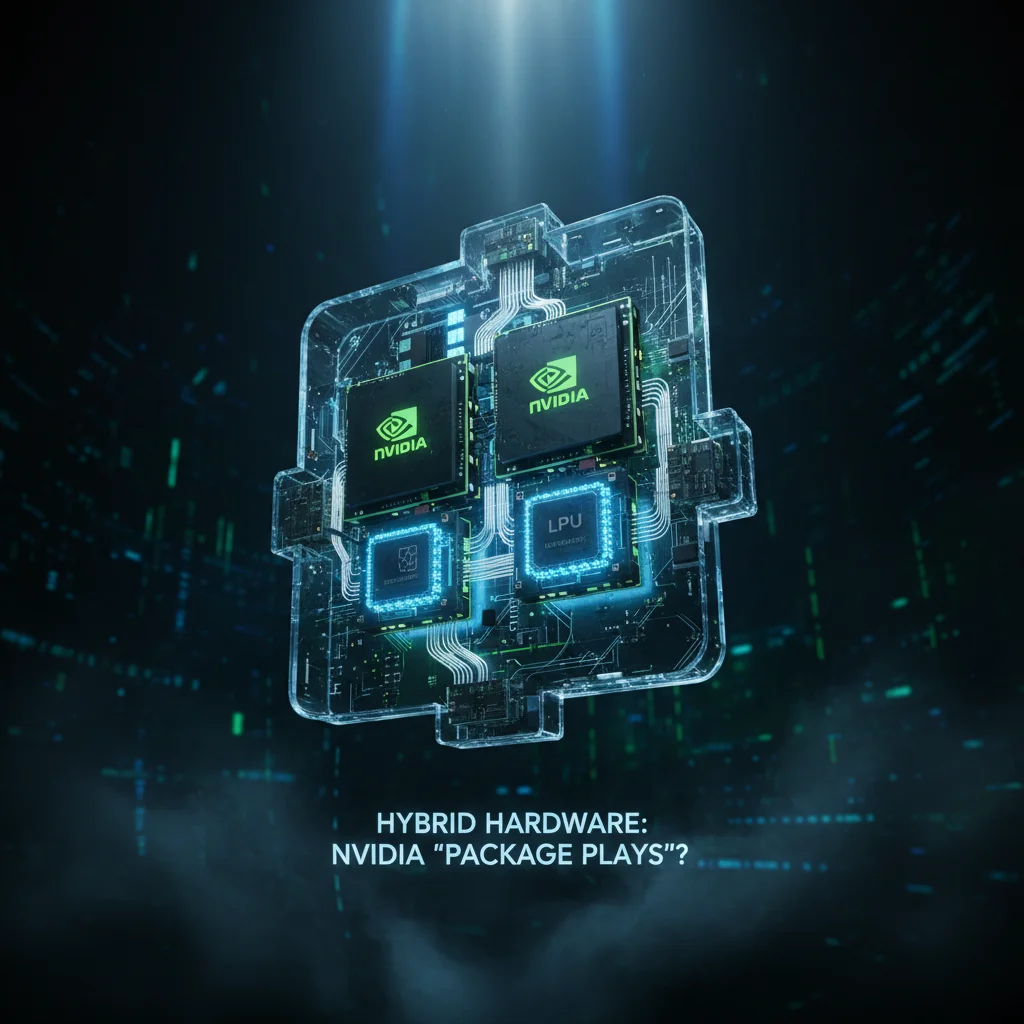
Hybrid Hardware: Will NVIDIA Soon Sell "Package Plays" of GPUs and LPUs?
The artificial intelligence landscape is evolving at breakneck speed. As generative AI models grow exponentially, the demand for specialized, efficient computing power has never been higher. NVIDIA, the undisputed titan of AI acceleration with its powerful GPUs and ubiquitous CUDA platform, faces new challenges from innovative architectures like Language Processing Units (LPUs).
This raises a crucial question for the future of AI hardware: Will NVIDIA, known for its strategic foresight, move beyond its GPU dominance to offer hybrid hardware "package plays" combining GPUs with LPUs or similar specialized chips? This deep dive explores the forces driving this potential shift, the technologies at play, and the strategic implications for the tech industry.
- NVIDIA dominates AI training with GPUs, but specialized LPUs challenge for efficient inference.
- Generative AI requires ultra-low-latency inference, a strength of purpose-built LPUs.
- Hybrid GPU+LPU systems could optimize AI workflow cost and performance for training and inference.
- The tech industry questions how NVIDIA will strategically respond to LPU competition.
What You'll Learn
The AI Hardware Landscape: NVIDIA's Reign and Emerging Contenders
For years, NVIDIA has been synonymous with artificial intelligence. Its Graphics Processing Units (GPUs), initially designed for rendering complex computer graphics, proved serendipitously perfect for the parallel processing demands of machine learning training.
The CUDA programming platform further solidified NVIDIA's ecosystem, creating a powerful moat that has been incredibly difficult for competitors to breach. This dominance has positioned NVIDIA at the heart of the generative AI revolution, supplying the computational muscle for everything from large language model (LLM) training to complex scientific simulations.
However, the AI world is not static. While GPUs excel at the brute-force parallel computation required for training massive AI models (AI pre-training), their efficiency can diminish when it comes to the specific, often sequential, demands of AI inference—especially for generative AI applications.
Inference, the process of using a trained AI model to make predictions or generate content, requires different optimizations. It often prioritizes low latency, high throughput, and energy efficiency over raw floating-point operations per second (FLOPS) for training.
This shift in demand has opened the door for specialized hardware. Companies like Groq have emerged with innovative architectures specifically designed for inference, often referred to as Language Processing Units (LPUs).
LPUs aim to achieve unprecedented speed and efficiency for sequential workloads, which are common in LLMs. Their approach typically involves minimizing external memory access and optimizing for predictable data flows, drastically reducing latency and boosting throughput for specific tasks.
Beyond Groq, other players like Google with its Tensor Processing Units (TPUs) and Cerebras with its wafer-scale engines also push the boundaries of specialized AI silicon. TPUs, initially internal to Google, have evolved through several generations, offering optimized performance for both training and inference workloads within Google Cloud.
Cerebras takes an entirely different approach, fabricating the largest chips ever made to solve massive AI problems with a single, highly parallelized piece of silicon. These developments signal a maturing AI hardware market, where a one-size-fits-all solution is becoming less optimal for all use cases.
NVIDIA dominates AI training with GPUs and CUDA, but the burgeoning demand for highly efficient, low-latency AI inference—especially for generative AI—is creating fertile ground for specialized hardware like LPUs, TPUs, and wafer-scale engines.
GPU vs. LPU: Core Strengths for AI Workloads
GPUs (NVIDIA)
Primary Strength: Massive parallel processing for AI model training (e.g., pre-training large LLMs). Versatile for various deep learning tasks. Strong ecosystem with CUDA.
LPUs (Groq)
Primary Strength: Ultra-low-latency, high-throughput sequential processing for AI inference (e.g., generative AI, LLM chatbots). Designed for predictable data flow and minimal memory bottlenecks.
Hybrid Potential
Synergy: Combine GPU for training heavy lifting with LPU for efficient, real-time inference. Optimize cost, performance, and energy across the AI lifecycle.
The Rise of LPUs and the Inference Challenge
The emergence of Large Language Models (LLMs) and generative AI applications has fundamentally altered the demands on AI hardware. While NVIDIA's GPUs remain supreme for the computationally intensive task of AI pre-training, the subsequent inference phase presents a distinct set of challenges.
For generative AI, inference often involves highly sequential processing, where the output of one step becomes the input for the next. This 'token-by-token' generation is particularly sensitive to latency, as users expect near-instantaneous responses from chatbots or AI assistants.
LPUs, pioneered by figures like Jonathan Ross (Groq's founder and former Google TPU architect), are built from the ground up to address these inference challenges. Their architectural philosophy diverges significantly from general-purpose GPUs.
LPUs often feature tightly integrated memory and compute, reducing the overhead of data movement—a significant bottleneck in traditional architectures. This design choice allows for highly predictable performance and extremely low latency for specific workloads.
"The critical insight for Groq was that the challenge of AI inference, especially for LLMs, wasn't just about raw compute power, but about predictable latency and sustained throughput for sequential operations. We designed an architecture that eliminates the bottlenecks of traditional systems."
Jonathan Ross, Founder and CEO of GroqThe economics of AI inference are becoming a major concern for businesses. As AI adoption scales, the cost per query, per token, or per generated image can quickly accumulate. Traditional GPUs, while powerful, can be over-provisioned for many inference tasks, leading to unnecessary power consumption and higher operational costs.
LPUs promise to deliver higher throughput per watt and lower latency, directly impacting the bottom line for companies deploying generative AI at scale. This focus on efficiency for deployment rather than just raw training power marks a significant shift in the AI hardware market.
The core innovation behind LPUs often lies in their ability to minimize external memory access. GPUs, by necessity, rely on high-bandwidth external memory (HBM) to feed their many cores. While HBM is incredibly fast, moving data on and off the chip still incurs latency and power penalties.
LPU designs attempt to keep data on-chip for as long as possible, using large on-chip memories and deterministic data flows to ensure computation happens at maximum speed without waiting for data. This is particularly effective for the fixed, sequential operations common in LLM inference.
When evaluating AI hardware, look beyond peak FLOPS. For inference-heavy generative AI applications, prioritize metrics like sustained throughput, latency per token, and power efficiency (tokens per watt) to truly understand real-world performance and cost-effectiveness.
The rise of LPUs doesn't necessarily mean the obsolescence of GPUs. Instead, it highlights a growing specialization within the AI hardware ecosystem. For businesses seeking to optimize their AI infrastructure, understanding these nuances is critical.
Agencies like Integradyn.ai regularly advise clients on navigating these complex technological choices. Our experts help service businesses evaluate the right hardware solutions to meet their specific AI deployment needs, ensuring both performance and cost efficiency.
Ready to Optimize Your AI Strategy?
Understanding the right hardware mix can dramatically impact your AI initiatives. Partner with Integradyn.ai to build a robust, future-proof AI infrastructure.
Schedule Your Free ConsultationNVIDIA's Strategic Playbook: Acquisition, Integration, or Competition?
NVIDIA’s history is a testament to its strategic agility and relentless innovation. From the gaming industry to professional visualization and then to AI, the company has consistently adapted and dominated by anticipating market shifts and building comprehensive ecosystems around its hardware.
Now, faced with the ascent of specialized inference chips, NVIDIA must once again decide its strategic response. The options are manifold: acquire a leading LPU company, integrate LPU-like functionalities into its existing GPU architectures, or directly compete with a new dedicated product line.
Acquisition presents a direct path to market entry and eliminates a competitor. A hypothetical acquisition of a company like Groq would instantly grant NVIDIA access to cutting-edge LPU technology, a team of specialized engineers, and a readymade product for inference.
However, such a move by a market leader like NVIDIA would undoubtedly face intense scrutiny from anti-trust regulators. Given NVIDIA's significant market share in AI chips, any major acquisition could trigger protracted legal battles and potential roadblocks, as seen with previous large tech mergers.
Any large-scale acquisition by NVIDIA in the specialized AI chip market, particularly involving a prominent player like Groq, would likely face significant anti-trust challenges, potentially delaying or preventing integration and market impact.
Another strategic avenue for NVIDIA is internal development and integration. NVIDIA could leverage its vast R&D resources to design its own specialized inference unit, perhaps a dedicated 'Inference Processing Unit' (IPU) or integrate LPU-like capabilities directly into future generations of its GPUs.
This approach would maintain NVIDIA's intellectual property control and avoid anti-trust hurdles. It would also allow them to build upon the existing CUDA ecosystem, potentially offering developers a unified programming model for both training and inference on NVIDIA hardware.
The concept of "package plays" comes into sharp focus here. NVIDIA could offer solutions that combine the best of both worlds: its powerful GPUs for AI pre-training and, potentially, a co-packaged or seamlessly integrated LPU-like component for inference.
This would allow customers to optimize their entire AI pipeline, from model development to deployment, within a single vendor's ecosystem. Such an offering would be highly compelling, promising efficiency gains across the board.
Assess the Inference Gap
NVIDIA first needs to definitively quantify the performance, latency, and power efficiency gap between its current GPUs and specialized LPUs for specific, high-growth generative AI inference workloads.
Evaluate Strategic Fit
Determine if an LPU-like offering aligns with NVIDIA's long-term vision, ecosystem strategy (CUDA), and overall market positioning, considering the economic and technical trade-offs.
Choose Path: Build, Buy, or Partner
Decide whether to develop an in-house solution, acquire an existing LPU company, or form strategic partnerships to bring LPU capabilities to market, weighing anti-trust, cost, and time factors.
Integrate Ecosystems
If new hardware is introduced, ensure seamless integration with the existing CUDA software stack and developer tools to maintain ecosystem strength and minimize developer friction.
Market and Scale
Position the new hybrid offering to address specific customer pain points in generative AI inference, demonstrating clear advantages in performance, efficiency, and total cost of ownership.
The decision will have profound implications for the entire AI ecosystem. Whatever path NVIDIA chooses, it will undoubtedly aim to reinforce its position as the dominant force in AI hardware, shaping the future of AI economics and technological trends for years to come.
The Future of AI Hardware and Ecosystems
The proliferation of specialized AI hardware signifies a maturing industry where efficiency and optimization are paramount. As AI models become ubiquitous, the hardware needs to be tailored not just for raw power, but for specific use cases like real-time generative inference, edge AI, and resource-constrained environments.
For developers, this evolving landscape presents both opportunities and challenges. The long-standing dominance of NVIDIA's CUDA platform has fostered a rich ecosystem of tools, libraries, and expertise.
However, new architectures like those from Groq (LPUs) or even emerging open-source hardware initiatives might require learning new frameworks or adapting existing codebases. The ideal scenario for many would be a unified, abstracted layer that allows developers to write code once and deploy efficiently across various specialized hardware.
This fragmentation risk is precisely why NVIDIA's strategic moves are so critical. If they can offer a seamless hybrid solution under the familiar CUDA umbrella, they can retain their ecosystem lock-in while addressing performance gaps.
The impact on AI pre-training versus fine-tuning and inference will be profound. While GPUs will likely remain the workhorse for initial massive pre-training, specialized chips could revolutionize fine-tuning and inference. This could lead to a more distributed and efficient AI compute fabric, reducing the reliance on centralized, GPU-heavy data centers for all AI tasks.
The broader tech industry trend points towards increased specialization in silicon. Companies are increasingly designing custom chips (ASICs) for their unique workloads, moving away from general-purpose processors where possible. This move is driven by the need for greater energy efficiency, lower latency, and optimized performance for specific applications.
The future of AI hardware is likely hybrid, with specialized chips complementing general-purpose GPUs for optimal performance across the entire AI lifecycle, from pre-training to inference. NVIDIA's ability to integrate these technologies seamlessly will be crucial for its continued dominance.
For service businesses aiming to leverage AI effectively, understanding these underlying hardware dynamics is not just for tech giants. According to the SEO specialists at Integradyn.ai, businesses that grasp these emerging tech trends can gain a significant competitive advantage.
By optimizing their AI infrastructure, they can offer faster, more reliable, and more cost-effective AI-powered services. The team at Integradyn.ai recommends a strategic assessment of your AI workloads to determine the most suitable and efficient hardware configurations for your specific needs.
Stay Ahead in the AI Race
The AI landscape is complex and ever-changing. Let Integradyn.ai's experts guide you through the intricacies of AI hardware, software, and strategy to ensure your business thrives.
Explore Our AI Consulting ServicesIntegradyn.ai’s expert team continuously monitors these shifts, providing actionable insights for service businesses looking to implement or scale their AI capabilities. From understanding the nuances of GPU versus LPU performance to optimizing cloud spend, our guidance helps businesses make informed decisions.
The question of NVIDIA's package plays isn't just about hardware; it's about the future of AI accessibility, efficiency, and the trajectory of technological innovation. It's about whether the industry will consolidate further or see a proliferation of specialized solutions. Only time will tell, but the stage is set for a fascinating evolution in AI computing.
Frequently Asked Questions About Hybrid AI Hardware
What is hybrid AI hardware?
Hybrid AI hardware refers to the combination of different types of specialized chips, such as GPUs and LPUs, working together to optimize various stages of the AI workflow, from training large models to performing efficient, low-latency inference.
Why are LPUs becoming important for AI?
LPUs (Language Processing Units) are becoming crucial because they are specifically designed for the sequential and low-latency demands of AI inference, especially for generative AI models like LLMs. They often offer greater efficiency and lower cost-per-token than general-purpose GPUs for these specific tasks.
What is the main difference between a GPU and an LPU?
GPUs (Graphics Processing Units) excel at highly parallel computations, making them ideal for training complex AI models. LPUs, on the other hand, are optimized for sequential processing and ultra-low latency inference, crucial for real-time generative AI responses. GPUs are general-purpose parallel processors; LPUs are highly specialized for specific inference tasks.
Will NVIDIA acquire Groq or a similar LPU company?
While speculative, it's a strategic possibility. Acquiring an LPU leader like Groq could give NVIDIA immediate access to specialized inference technology. However, such a move would face significant anti-trust scrutiny due to NVIDIA's dominant market position.
What are 'package plays' in the context of NVIDIA and AI chips?
'Package plays' refer to NVIDIA offering integrated solutions that combine different types of chips, such as GPUs for training and LPUs for inference, potentially co-packaged or seamlessly integrated, to provide a comprehensive and optimized hardware solution for the entire AI lifecycle.
How does CUDA fit into the future of hybrid hardware?
CUDA is NVIDIA's powerful software platform for GPUs. For hybrid hardware, NVIDIA would likely aim to extend CUDA's capabilities or create new, compatible frameworks to allow developers to seamlessly program and manage both GPUs and any co-existing LPUs, maintaining their ecosystem advantage.
What is AI inference, and why is it different from AI training?
AI training involves feeding vast amounts of data to an AI model to teach it patterns and relationships, creating the model itself. AI inference is the subsequent process of using that trained model to make predictions, generate content, or perform tasks based on new input data. Inference prioritizes speed and efficiency, while training prioritizes raw computational power.
Who is Jonathan Ross?
Jonathan Ross is a key figure in specialized AI hardware, known as the founder and CEO of Groq. Before founding Groq, he was instrumental in the development of Google's Tensor Processing Unit (TPU) during his tenure there.
What is the role of TPUs and Cerebras in the AI chip market?
Google's TPUs are specialized ASICs designed to accelerate machine learning workloads, primarily used internally by Google but also offered via Google Cloud. Cerebras Systems develops wafer-scale engines, which are exceptionally large chips designed for massive AI training tasks, representing another facet of specialized AI hardware.
How will specialized hardware impact AI economics?
Specialized hardware is expected to significantly improve AI economics by reducing the cost and power consumption of AI inference, especially for generative AI. Lower latency and higher throughput translate to more cost-effective deployment and scaling of AI applications.
Are there anti-trust concerns regarding NVIDIA's market dominance?
Yes, NVIDIA's significant market share in AI chips (especially GPUs) often raises anti-trust concerns. Any major acquisition or aggressive market moves could attract regulatory scrutiny aimed at preventing monopolistic practices and fostering competition.
What are the benefits of a hybrid hardware approach for businesses?
A hybrid hardware approach allows businesses to leverage the best of both worlds: GPUs for efficient model training and specialized LPUs for cost-effective, low-latency inference. This optimizes performance, reduces operational costs, and provides flexibility across the entire AI development and deployment lifecycle.
How can businesses prepare for these shifts in AI hardware?
Businesses should regularly assess their AI workloads, understand their specific training and inference needs, and stay informed about emerging hardware technologies. Partnering with AI strategy experts, like those at Integradyn.ai, can help navigate these complex decisions and optimize infrastructure investments.
Will specialized hardware lead to vendor lock-in?
Potentially. If a single vendor offers a highly integrated and optimized hybrid solution, developers might become reliant on that vendor's ecosystem (e.g., CUDA). However, the growing open-source AI community and efforts towards hardware abstraction aim to mitigate this risk.
What is the ultimate goal of specialized AI chips?
The ultimate goal is to achieve maximum efficiency, performance, and cost-effectiveness for every stage of the AI workflow. This means developing hardware that perfectly matches the computational demands of specific tasks, from massive parallel training to ultra-fast, sequential inference.
The future of AI hardware is undoubtedly hybrid, dynamic, and rapidly innovating. NVIDIA stands at a crucial juncture, poised to redefine its role in the evolving AI ecosystem. Whether through bold acquisitions, internal R&D, or strategic partnerships, the semiconductor giant's next moves will shape the performance, accessibility, and economics of artificial intelligence for decades to come.
For businesses, staying informed and adaptable is key. Understanding these technological currents, as emphasized by experts at Integradyn.ai, is essential for leveraging AI effectively and maintaining a competitive edge in an increasingly AI-driven world.
Legal Disclaimer: This article was drafted with the assistance of AI technology and subsequently reviewed, edited, and fact-checked by human writers to ensure accuracy and quality. The information provided is for educational purposes and should not be considered professional advice. Readers are encouraged to consult with qualified professionals for specific guidance.