NVIDIA Nitrogen: Vision-Action AI Revolutionizing Gaming & Beyond
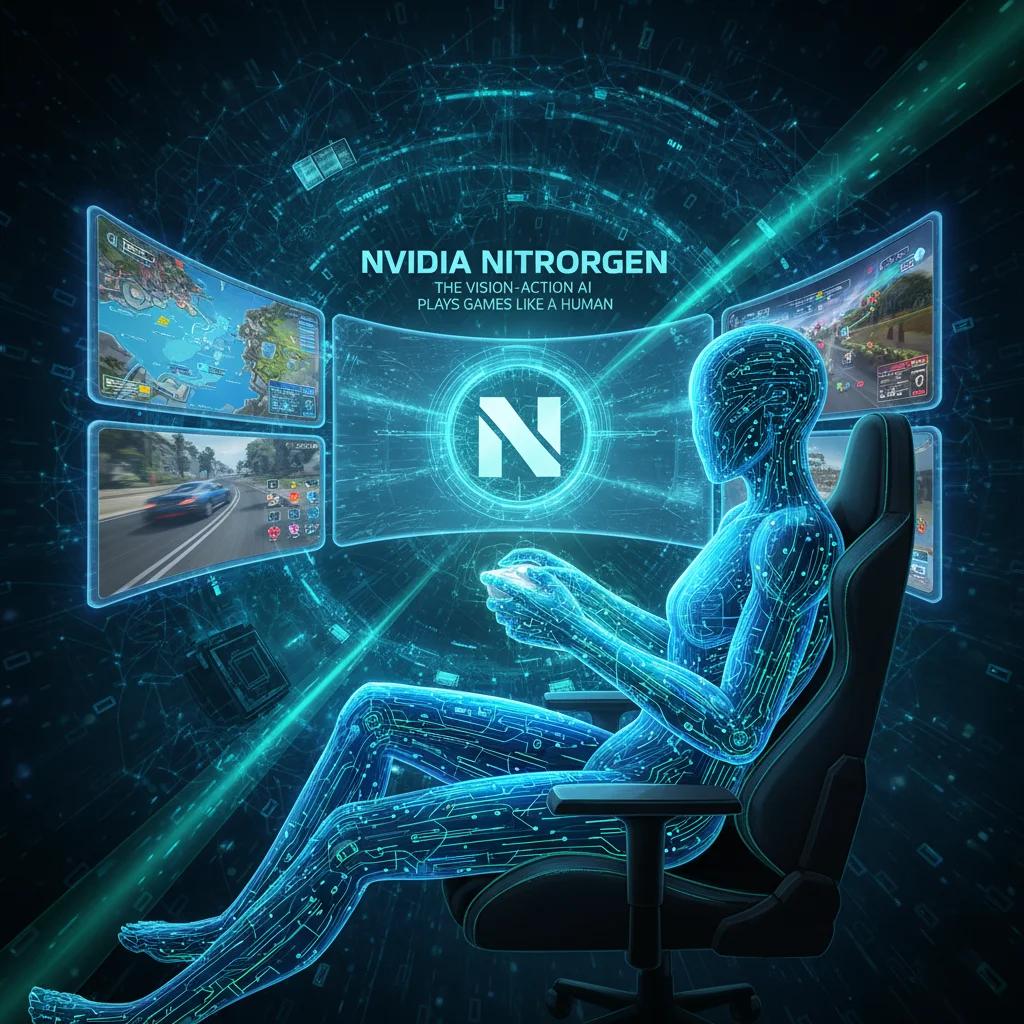
NVIDIA Nitrogen: The Dawn of Vision-Action AI
In the rapidly evolving landscape of Artificial Intelligence, breakthroughs are constantly redefining what machines are capable of. From sophisticated language models to advanced generative algorithms, the pace of innovation is breathtaking. Yet, one frontier has consistently challenged AI researchers: achieving human-like intuition and adaptability in dynamic, real-time environments.
- NVIDIA Nitrogen operates as a Vision-Action AI, learning from raw pixels rather than code.
- It mimics human intuition by combining computer vision with deep reinforcement learning.
- The technology bridges the gap between virtual gaming skills and real-world robotic autonomy.
- Nitrogen adapts strategies in real-time, moving beyond static pattern recognition.
Enter NVIDIA Nitrogen, a visionary project poised to fundamentally transform our understanding of AI. This isn't just another intelligent agent; it's a Vision-Action AI designed to play complex games with a level of insight and strategy previously thought exclusive to humans. It marks a significant leap in the integration of computer vision, deep learning, and adaptive decision-making.
Nitrogen moves beyond mere pattern recognition to encompass true environmental understanding and strategic execution. Its ability to process visual information, interpret context, and perform intricate actions offers a compelling glimpse into the future of AI capabilities.
What You'll Learn
Unveiling Nitrogen: Vision-Action AI Explained
NVIDIA Nitrogen emerges as a beacon in the field of advanced machine intelligence, demonstrating a paradigm shift from traditional AI approaches. At its heart, Nitrogen is a sophisticated Vision-Action AI system. It perceives its environment visually and translates those perceptions directly into actions, mimicking how humans interact with the world.
Unlike previous AI models that rely on structured data inputs or direct API access to game states, Nitrogen operates solely from raw visual input. This allows it to develop a richer, more contextual understanding of the game world. Its advanced computer vision capabilities enable it to identify objects, characters, game states, and strategic opportunities dynamically.
The prowess of Nitrogen stems from its intricate deep learning architecture. These highly complex neural networks are not simply programmed with rules; they learn by observing and interacting within the game environment. This iterative process allows Nitrogen to develop emergent strategies and adapt to unforeseen circumstances.
Beyond Pixels: How Nitrogen Learns and Adapts
The true genius of NVIDIA Nitrogen lies not just in its perception, but in its sophisticated learning mechanisms. It transcends simple pixel interpretation, delving into contextual understanding and strategic evolution. This involves an intricate dance between raw visual data and intelligent decision-making.
Nitrogen leverages advanced neural networks designed for sequential decision-making. These networks are trained using massive datasets derived from gameplay, often through self-play. This self-supervised learning paradigm allows the AI to explore a vast space of possibilities far beyond human-labeled data.
The process begins with a computer vision module that acts as the AI's "eyes." It processes screen captures frame by frame, extracting salient features and converting them into a high-level representation of the game state. It learns to identify objects, movement vectors, and inferred intentions of other agents.
Nitrogen moves from "knowing the rules" to "understanding the game." By coupling visual input with reinforcement learning, it builds an internal model of the world, allowing it to predict and plan rather than just react.
Following visual interpretation, Nitrogen employs advanced reinforcement learning algorithms. The AI receives rewards for successful actions and penalties for failures. Through countless iterations, it refines its internal policy, discovering optimal strategies that might elude human designers.
"NVIDIA Nitrogen's ability to derive strategic meaning from raw pixels, without explicit programming for each game element, represents a profound shift in autonomous intelligence."
NVIDIA Research TeamThe Strategic Implications: Gaming, Simulation, and Beyond
NVIDIA Nitrogen's capabilities extend far beyond playing games; they serve as a blueprint for future intelligent systems. The ability to perceive, learn, and act with human-like intuition unlocks new frontiers for technological innovation.
In gaming, Nitrogen promises a revolution of infinitely replayable scenarios. AI opponents will adapt to play styles, learn weaknesses, and devise counter-strategies on the fly. Developers can use this technology for rigorous game testing, identifying bugs and unbalanced mechanics more efficiently than traditional methods.
However, the transition from gaming to general simulation is where Nitrogen truly shines. Any environment that can be visually rendered becomes a training ground. This is particularly transformative for autonomous vehicle development and robotics.
In robotics, Nitrogen-like systems enable machines to perform intricate tasks in unstructured environments. Instead of being explicitly programmed for every variable, a robot can learn to "see" and "understand" its workspace. This accelerates the deployment of intelligent robots in manufacturing and logistics.
Look for "Sim2Real" applications when evaluating AI tech. Nitrogen's architecture is designed to train in a safe, high-speed virtual simulation and then transfer those learned behaviors to physical robots, drastically reducing real-world training costs.
The Road Ahead: Challenges and Opportunities
The emergence of NVIDIA Nitrogen signifies a monumental stride in Artificial Intelligence, but the path forward contains significant challenges. Understanding these dynamics is crucial for harnessing the full potential of Vision-Action AI.
One primary challenge is the immense computational resource requirement. The scale of neural networks and the volume of data processed demand cutting-edge hardware. Optimizing these models for efficiency remains a critical research area.
Another hurdle is achieving true generalization. While Nitrogen can adapt to new games within a domain, transitioning from gaming to robotic control requires breakthroughs in transfer learning. Bridging the gap between specialized intelligence and general-purpose AI is the next grand challenge.
Despite these hurdles, the opportunities are profound. Nitrogen's ability to learn from observation could revolutionize education through personalized learning AI. It also offers powerful new tools for scientific discovery, allowing researchers to model complex systems with unprecedented accuracy.
Ready to Transform Your Business?
Discover how cutting-edge AI solutions can redefine your industry. Partner with Integradyn.ai to explore the future of intelligent automation.
Schedule Your Free CallFrequently Asked Questions
What distinguishes Nitrogen from traditional AI?
Traditional AI often relies on pre-programmed rules or direct access to data code. Nitrogen uses Vision-Action technology to interpret raw visual pixels, learning strategies through observation similar to human cognition.
Can Nitrogen play any game?
While highly adaptable, Nitrogen requires training for specific environments. However, its strength lies in generalization; once it learns the principles of a genre, it can adapt to similar games with significantly less training.
What are the real-world applications?
Beyond gaming, this technology is pivotal for robotics, autonomous vehicles, and industrial simulations. It allows machines to navigate and operate in unstructured, dynamic real-world environments.
How does it handle incomplete information?
Nitrogen uses deep learning to infer missing data based on visual cues and learned game mechanics. This probabilistic prediction allows it to function effectively even when it cannot "see" the entire map or state.
Legal Disclaimer: This article was drafted with the assistance of AI technology and subsequently reviewed, edited, and fact-checked by human experts at Integradyn.ai to ensure accuracy and quality. The information provided is for educational purposes.