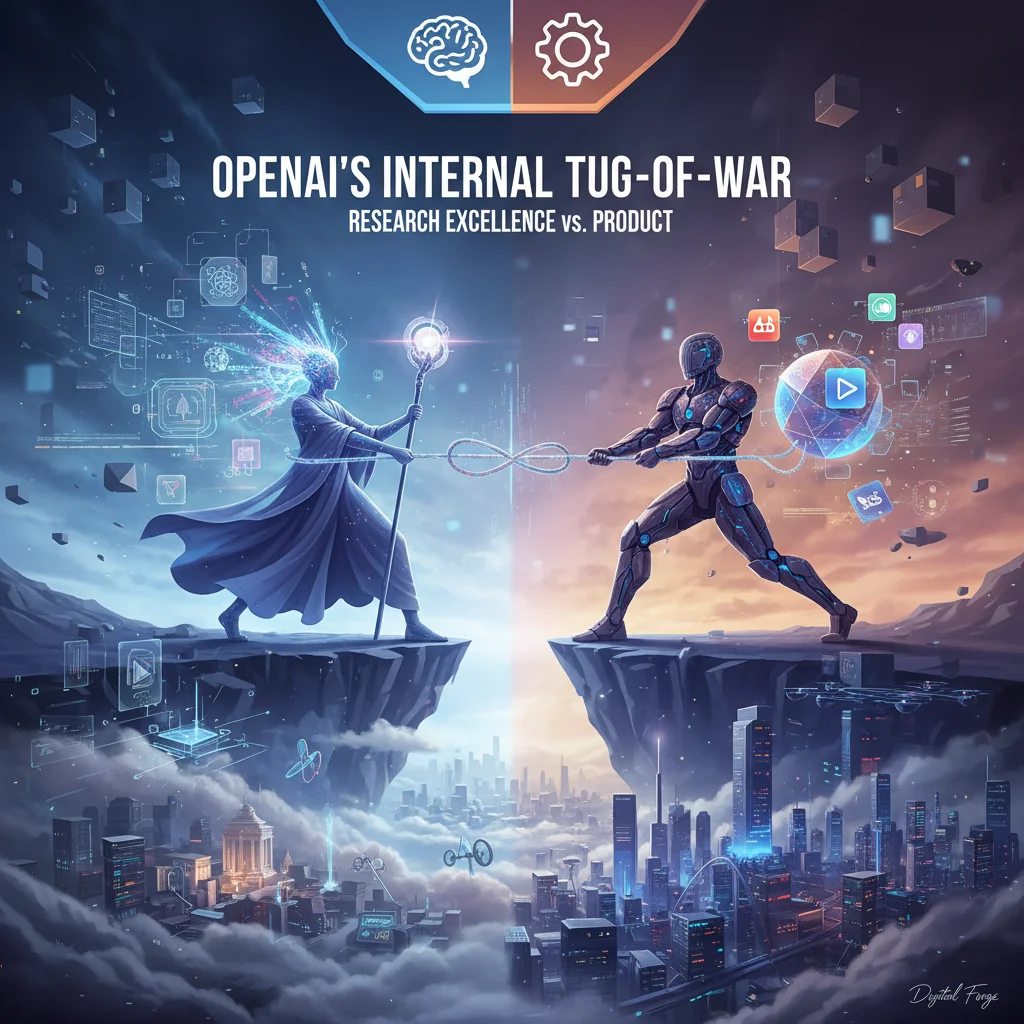
OpenAI’s Internal Tug-of-War: Research Excellence vs. Product Powerhouse
OpenAI stands at the vanguard of artificial intelligence, a name synonymous with groundbreaking innovation and transformative technology. Yet, beneath its polished exterior and world-changing announcements, a fundamental tension simmers: the delicate, often precarious, balance between pursuing pure research excellence and delivering robust, market-ready products.
This internal tug-of-war isn't just an organizational challenge; it’s a strategic crucible that shapes the future of AI. It impacts everything from funding allocation and talent retention to the ethical implications of deploying powerful models. For businesses striving to harness AI, understanding this dynamic within a titan like OpenAI offers crucial insights into adoption strategies and future trends.
In the rapidly evolving landscape of AI, where digital marketing and lead generation are increasingly influenced by intelligent systems, the decisions made at OpenAI reverberate across industries. The interplay between ambitious research goals and aggressive product roadmaps defines not only OpenAI's trajectory but also the broader direction of artificial intelligence development.
- OpenAI grapples with a core tension between its foundational research mission for AGI and the commercial imperative to deliver market-leading AI products.
- The shift from a pure non-profit to a capped-profit model introduced new pressures for rapid product development and revenue generation.
- Prioritizing research excellence ensures long-term breakthroughs and ethical AI, but product focus drives immediate utility, funding, and user adoption.
- Internal leadership disputes and strategic pivots highlight the ongoing struggle to reconcile these often-conflicting objectives.
- Understanding this dynamic is crucial for businesses, informing their AI adoption strategies and demonstrating why expert guidance, like that from Integradyn.ai, is vital for leveraging AI in digital marketing and lead generation effectively.
What You'll Learn
The Genesis of a Dichotomy: OpenAI's Dual Mission
OpenAI was founded in 2015 with a bold and idealistic vision: to ensure that artificial general intelligence (AGI)—AI systems capable of human-level cognitive abilities—benefits all of humanity. Initially structured as a non-profit organization, its stated goal was to conduct pioneering research in a safe and open manner, free from the commercial pressures that often steer technological development.
This original mission emphasized research excellence above all else. Early work focused on reinforcement learning, robotics, and fundamental AI safety questions, positioning OpenAI as a beacon of long-term, ethically-driven innovation. The emphasis was on exploration, not immediate monetization.
However, the pursuit of AGI proved incredibly resource-intensive. Developing cutting-edge AI models required vast computational power, top-tier talent, and significant financial investment. The limitations of a pure non-profit model soon became apparent.
In 2019, OpenAI made a pivotal strategic shift, introducing a "capped-profit" subsidiary. This hybrid structure allowed it to attract substantial investment, most notably from Microsoft, while theoretically maintaining its commitment to its founding mission. Investors could see returns, but with a cap, ensuring that profit didn't overshadow the broader benefit to humanity.
This organizational change, while necessary for survival and accelerated progress, immediately created the very dichotomy we observe today. The influx of capital brought an expectation of tangible returns and product delivery, adding a commercial imperative to the existing research mandate. The pure pursuit of AGI now had a co-pilot: the need to demonstrate value and generate revenue.
This dual identity has shaped every subsequent decision, from hiring strategies to project prioritization. It’s a constant negotiation between the long-term, exploratory work required for AGI and the short-term demands of a competitive market.
For businesses engaged in digital marketing and lead generation, this internal structure at OpenAI has profound implications. The speed at which research breakthroughs translate into usable tools directly impacts their ability to innovate and compete. Understanding this foundational tension helps anticipate future product releases and the direction of AI capabilities that can be leveraged for business growth.
The early days of OpenAI saw significant investment in theoretical research and foundational models that wouldn't necessarily see immediate public deployment. This was the era of pushing boundaries for science's sake, fostering a culture of academic freedom and ambitious, often speculative, projects. Researchers were encouraged to explore, even if the commercial application wasn't immediately clear.
However, with the establishment of the capped-profit arm, the focus began to subtly shift. While the ultimate goal of AGI remained, the path to achieving it now included generating substantial revenue to fund increasingly expensive compute and talent. This meant a greater emphasis on applied research and developing models that could be packaged into products.
The successful launch of products like ChatGPT vividly illustrates the outcome of this strategic pivot. It brought AI directly into the public consciousness and demonstrated the immense commercial potential of cutting-edge research. Yet, it also intensified the internal pressure to prioritize product development cycles and market demands.
This ongoing negotiation within OpenAI is a microcosm of a broader challenge facing the entire AI industry. How do you balance the long-term, ethically complex, and expensive pursuit of true intelligence with the immediate, tangible benefits of current AI applications? It’s a question agencies like Integradyn.ai often address when advising clients on integrating AI into their digital strategies.
OpenAI's foundational shift from pure non-profit to a capped-profit model created an inherent tension between its long-term AGI research mission and the commercial need for product development and revenue, directly influencing the pace and direction of AI innovation.
OpenAI's Evolution: Research vs. Product Emphasis
Founding (2015-2018)
Primary Focus: Pure AGI research, safety, open access. Less emphasis on immediate commercialization. Long-term scientific exploration.
Capped-Profit Shift (2019-2021)
Primary Focus: Attracting capital for compute/talent. Research still core, but growing awareness of product potential. Developing foundational models with future applications.
Product Acceleration (2022-Present)
Primary Focus: Rapid product development (ChatGPT, API), user growth, revenue. Research informs products, but commercial timelines often dictate priorities. Balancing act intensifies.
The Research Imperative: Pushing the Frontiers of AI
Despite the growing commercial pressures, OpenAI's heart remains in research. Its commitment to pioneering breakthroughs, particularly in areas like AI safety, alignment, and the development of increasingly sophisticated foundational models, is unwavering. This research imperative drives the entire organization's long-term vision.
The pursuit of Artificial General Intelligence (AGI) is a monumental task, requiring sustained, deep theoretical work that often doesn't have immediate product applications. Projects focused on understanding emergent behaviors in large language models, developing robust safety protocols, and ensuring AI systems align with human values are critical, yet don't always translate into a direct revenue stream in the short term.
OpenAI's research division is renowned for attracting some of the world's brightest minds in AI. These researchers are often motivated by the intellectual challenge and the potential for scientific discovery, rather than strict product deadlines. The culture fosters academic freedom, allowing for exploratory work that might seem abstract but could unlock future generations of AI capabilities.
The development of models like GPT-4, DALL-E 3, and specialized robotics projects stem from this deep research focus. These aren't just incremental improvements; they represent significant leaps in AI's understanding, generation, and interaction capabilities. Such advancements are the lifeblood of OpenAI's long-term competitive advantage.
However, this pure research focus comes with its own set of challenges within a commercializing entity. Resources, both computational and human, are finite. Allocating them to long-horizon research projects can sometimes feel at odds with the urgent need to deliver features and maintain market leadership for existing products.
The "why" behind OpenAI’s existence—the safe and beneficial development of AGI—rests squarely on the shoulders of its research teams. Without their relentless pursuit of new knowledge and deeper understanding, the entire project loses its original meaning. This ethos is powerful, providing a north star for the organization even amidst commercial tides.
"The long-term mission of ensuring AGI benefits humanity demands a relentless, almost philosophical, dedication to foundational research. This can't be sacrificed for quarterly earnings if we truly want to build something transformative and safe."
This commitment to research also informs the strategic advice offered by leading digital marketing agencies. Experts at Integradyn.ai, for example, constantly monitor the latest research papers and breakthroughs from OpenAI and similar institutions. This proactive approach allows them to anticipate how new AI capabilities will impact SEO, content creation, and lead generation strategies, ensuring clients are always ahead of the curve.
The challenge, therefore, lies in fostering an environment where this vital research can thrive while simultaneously supporting the robust product development necessary for funding and impact. It’s a balancing act that requires visionary leadership and a clear understanding of both scientific potential and market realities.
Forward-thinking businesses should subscribe to OpenAI's research updates and follow leading AI researchers. Understanding the fundamental progress being made in AI today can provide invaluable foresight for future digital marketing and lead generation strategies.
Consider the computational demands of training a model like GPT-4. Such an endeavor costs hundreds of millions of dollars and requires massive energy consumption. Justifying such investments for pure research, without a clear, immediate path to productization, becomes increasingly difficult when shareholders and market competitors are breathing down your neck.
Yet, it is precisely these investments in seemingly abstract research that yield the dramatic breakthroughs that redefine industries. The long-term view of the research imperative understands that incremental product features are temporary, but fundamental shifts in AI capability are revolutionary. This is the delicate tension that defines OpenAI.
According to the SEO specialists at Integradyn.ai, even abstract AI research eventually filters down to practical applications for businesses. Whether it's improved natural language understanding for better content optimization or more sophisticated predictive analytics for lead generation, the roots are in foundational research. Ignoring this pipeline means missing future opportunities.
Ready to Transform Your Business with AI?
Leverage the power of cutting-edge AI for superior digital marketing and lead generation. Our experts at Integradyn.ai are ready to guide you.
Schedule Your Free CallThe Product Drive: Commercialization and Market Dominance
While research remains crucial, the product drive at OpenAI has undeniably taken center stage in recent years. The launch of ChatGPT in late 2022 marked a pivotal moment, transforming OpenAI from a respected research lab into a global technology phenomenon. This single product alone ignited public interest in AI and demonstrated its immediate commercial viability on an unprecedented scale.
The success of ChatGPT, followed by the robust developer API, DALL-E, and various plugins, has created immense pressure to iterate rapidly, acquire users, and generate substantial revenue. This shift requires a different organizational mindset: one focused on product-market fit, user experience, scalability, and competitive advantage. The clock is always ticking in the fast-paced tech industry.
This product-centric approach prioritizes speed of deployment and user feedback. Engineering teams work tirelessly to refine models, improve performance, and build user-friendly interfaces. The goal is to get powerful AI tools into the hands of as many people and businesses as possible, as quickly as possible. This 'release fast and iterate' philosophy is standard for Silicon Valley startups but can conflict with the more deliberate pace of pure scientific research.
The need for revenue is not just about profit; it's about self-sustenance. Developing state-of-the-art AI is extraordinarily expensive. The billions invested by Microsoft, while significant, are finite. To continue attracting top talent, funding massive compute clusters, and sustaining research, OpenAI needs reliable, growing income streams. Products are the primary vehicle for achieving this financial independence.
Over-prioritizing short-term product gains without adequate foundational research can lead to stagnation, missed long-term breakthroughs, and increased risks from inadequately tested AI models.
The rapid adoption of OpenAI's products by businesses for tasks like content generation, customer service, and data analysis underscores their immediate value. This demand further fuels the product drive, creating a virtuous cycle where commercial success funds more development, which in turn leads to more successful products.
Digital marketing experts at Integradyn.ai understand this product velocity. They constantly evaluate how new OpenAI features and API capabilities can be integrated into client strategies for improved SEO performance, more efficient content creation, and highly targeted lead generation campaigns. Staying abreast of these product developments is crucial for maintaining a competitive edge.
However, the emphasis on rapid product deployment also brings increased scrutiny regarding safety, bias, and ethical implications. Releasing powerful, general-purpose AI models to millions of users means encountering unforeseen use cases and potential misuses. This necessitates rigorous testing and safety protocols, which can sometimes slow down the very product cycle it aims to accelerate.
The commercial success of OpenAI's products has fundamentally reshaped the organization. It provides the financial engine needed to pursue its audacious AGI goals, but it also creates a strong pull towards market-driven decisions. The delicate art is in ensuring that the product tail doesn't wag the research dog entirely, preserving the long-term vision that sets OpenAI apart.
Identify Market Needs
Proactively scan for real-world problems that cutting-edge AI models can solve, converting research potential into practical solutions for businesses and consumers.
Rapid Prototyping & Beta Testing
Quickly develop minimum viable products (MVPs) and release them to controlled user groups for immediate feedback, accelerating the iteration cycle.
Scalable Infrastructure
Invest heavily in robust, scalable infrastructure to handle millions of users and ensure seamless, high-performance product delivery globally.
Continuous User Feedback Loop
Establish strong channels for collecting and analyzing user feedback to inform product improvements, feature development, and bug fixes, ensuring user satisfaction and retention.
Navigating the Crossroads: Impact on Strategy and Future
The internal tug-of-war at OpenAI isn't merely theoretical; it has tangible impacts on its strategic direction, leadership decisions, and the future of AI development. The very public leadership crisis in late 2023, involving CEO Sam Altman and the board, brought this tension into sharp relief. It highlighted fundamental disagreements about the pace of AGI development, the balance between safety and commercialization, and the overall governance of such a powerful entity.
These events underscore the deep philosophical divides within the organization regarding how to best pursue its dual mission. Should research be prioritized above all else, even if it means slower product rollout? Or should rapid productization and market capture be the primary means to fund and steer long-term AGI development?
The role of investors, particularly Microsoft, also adds another layer of complexity. While Microsoft shares OpenAI's long-term vision, its investment of billions of dollars inherently comes with expectations for integration, competitive advantage, and ultimately, returns. This external pressure can further tip the scales towards product-focused outcomes.
Balancing aggressive product launches with meticulous safety research is a constant tightrope walk. Every new model release brings with it potential societal impacts that need careful consideration. The research team’s warnings about potential risks must be heard and acted upon, even when product deadlines loom large. This requires unprecedented collaboration and mutual respect between different divisions.
The future of OpenAI, and by extension, a significant portion of the AI industry, depends on how effectively this balance is managed. A complete pivot towards either extreme could be detrimental. An exclusive focus on research might lead to brilliant but unapplied discoveries, lacking the resources or public exposure to make a real-world difference. Conversely, an exclusive focus on products might lead to powerful but potentially unsafe or misaligned AI, sacrificing the long-term ethical vision.
For businesses looking to integrate AI into their operations, understanding this strategic balancing act is vital. It influences the stability of AI tools, the frequency of updates, and the ethical considerations that must be factored into their own digital marketing and lead generation strategies. Agencies like Integradyn.ai meticulously track these developments to provide reliable, forward-looking advice.
Digital marketing experts at Integradyn.ai observe that companies embracing AI for SEO and lead generation must be adaptable. OpenAI's strategic decisions, like the rollout of new API features or changes in model capabilities, directly impact the tools and techniques available. Our team helps clients navigate these shifts seamlessly.
Ultimately, OpenAI's internal tug-of-war is a reflection of the broader societal challenge: how do we responsibly develop and deploy technology that holds the potential to reshape human existence? The answer is likely not in choosing one path over the other, but in finding dynamic equilibrium where both research excellence and product utility can mutually reinforce each other.
"The tension between fundamental research and commercialization is not unique to OpenAI, but it's amplified by the profound impact of AI. Successful companies will be those that can create a symbiotic relationship where product success funds the research that leads to the next generation of revolutionary products."
This symbiotic relationship means research teams inform product development with cutting-edge insights and safety considerations. In turn, product teams provide invaluable real-world data and user feedback that can guide future research directions, making it more relevant and impactful. It’s a continuous feedback loop that, when optimized, propels both forward.
The team at Integradyn.ai recommends that businesses considering significant AI investments look beyond the surface. Evaluate not just a tool's current capabilities, but also the underlying philosophy of its developer. Is there a strong commitment to continuous innovation and ethical development? This due diligence is critical for long-term strategic planning.
The path forward for OpenAI will likely involve further refinement of its governance structure and internal processes to manage this inherent tension more effectively. The world watches, recognizing that the choices made within this organization will have far-reaching implications for the future of AI and its integration into every facet of our lives, from personalized digital marketing campaigns to global scientific discovery.
Drive Your Digital Growth with AI Expertise
Don't just keep up with AI trends – lead with them. Integradyn.ai provides bespoke strategies for SEO, lead generation, and integrating AI into your business.
Explore Our AI SolutionsFrequently Asked Questions
What is the core mission of OpenAI?
OpenAI's core mission is to ensure that artificial general intelligence (AGI)—AI systems capable of human-level cognitive abilities—benefits all of humanity. This involves conducting advanced AI research and promoting its safe and responsible development.
Why did OpenAI shift from a non-profit to a capped-profit structure?
The shift was primarily driven by the immense financial and computational resources required to develop advanced AI models. The capped-profit structure allowed OpenAI to attract significant investment, like that from Microsoft, while attempting to retain its ethical mission by limiting investor returns.
What is the main tension between research and product at OpenAI?
The main tension lies in balancing the long-term, expensive, and often experimental pursuit of foundational AGI research with the immediate commercial pressure to develop and release market-ready products, acquire users, and generate revenue.
How does this tension impact OpenAI's strategy?
This tension influences resource allocation, project prioritization, leadership decisions, and the pace at which new technologies are developed and deployed. It requires constant negotiation between scientific exploration and market demands.
What is AGI, and why is it important to OpenAI?
AGI, or Artificial General Intelligence, refers to hypothetical AI with the ability to understand, learn, and apply intelligence to any intellectual task that a human being can. It's important to OpenAI because it's their ultimate long-term goal, aiming to develop it safely for humanity's benefit.
How do OpenAI's products, like ChatGPT, fit into this dynamic?
ChatGPT is a prime example of a successful product stemming from OpenAI's research. It demonstrates the commercial viability of their models, generates revenue, and provides valuable user feedback, but also increases pressure for rapid product iteration and commercialization.
What role does AI safety research play at OpenAI?
AI safety research is paramount, focusing on ensuring AI systems are robust, unbiased, and aligned with human values. This crucial, long-term research aims to mitigate potential risks associated with powerful AI and is often at the core of the research-vs-product debate.
How does Microsoft's investment affect OpenAI's direction?
Microsoft's multi-billion dollar investment provides crucial funding and computational resources. While supportive of the AGI mission, it also introduces external expectations for product integration and competitive advantage, subtly influencing the balance towards product development.
What are the benefits of a strong research focus for OpenAI?
A strong research focus ensures long-term breakthroughs, fosters innovation beyond immediate commercial applications, attracts top scientific talent, and underpins the ethical development of advanced AI, fulfilling OpenAI's founding mission.
What are the benefits of a strong product focus for OpenAI?
A strong product focus generates essential revenue to fund expensive research, allows for rapid user adoption and feedback, establishes market leadership, and translates cutting-edge AI into practical tools that benefit businesses and consumers globally.
How do digital marketing agencies like Integradyn.ai monitor OpenAI's developments?
Agencies like Integradyn.ai actively track OpenAI's research publications, product announcements, and API updates. This continuous monitoring allows them to anticipate trends and integrate the latest AI capabilities into client strategies for SEO, lead generation, and content creation.
Can OpenAI successfully balance both research and product?
Achieving this balance is one of OpenAI's biggest challenges. Success relies on visionary leadership, robust internal governance, clear communication between teams, and a symbiotic relationship where product success funds research, which in turn drives better products.
What happened during the OpenAI leadership crisis in 2023?
The 2023 leadership crisis involved a temporary ousting of CEO Sam Altman by the board, largely stemming from disagreements about the pace of AGI development and the balance between safety, research, and commercialization. Altman was later reinstated with a new board structure.
How does this internal tension affect businesses using OpenAI's tools?
It can impact the stability, update frequency, and ethical considerations of the tools. Businesses must stay informed and adapt their strategies, highlighting the need for expert guidance from digital marketing specialists like those at Integradyn.ai.
What advice does Integradyn.ai offer businesses regarding AI adoption?
Integradyn.ai advises businesses to continuously monitor AI developments, understand the underlying philosophies of AI providers, and strategically integrate AI into their digital marketing and lead generation efforts. We emphasize adaptability and leveraging AI for competitive advantage.
Legal Disclaimer: This article was drafted with the assistance of AI technology and subsequently reviewed, edited, and fact-checked by human writers to ensure accuracy and quality. The information provided is for educational purposes and should not be considered professional advice. Readers are encouraged to consult with qualified professionals for specific guidance.