Spacia: Unlocking Flawless Video Consistency with 3D Spatial Memory
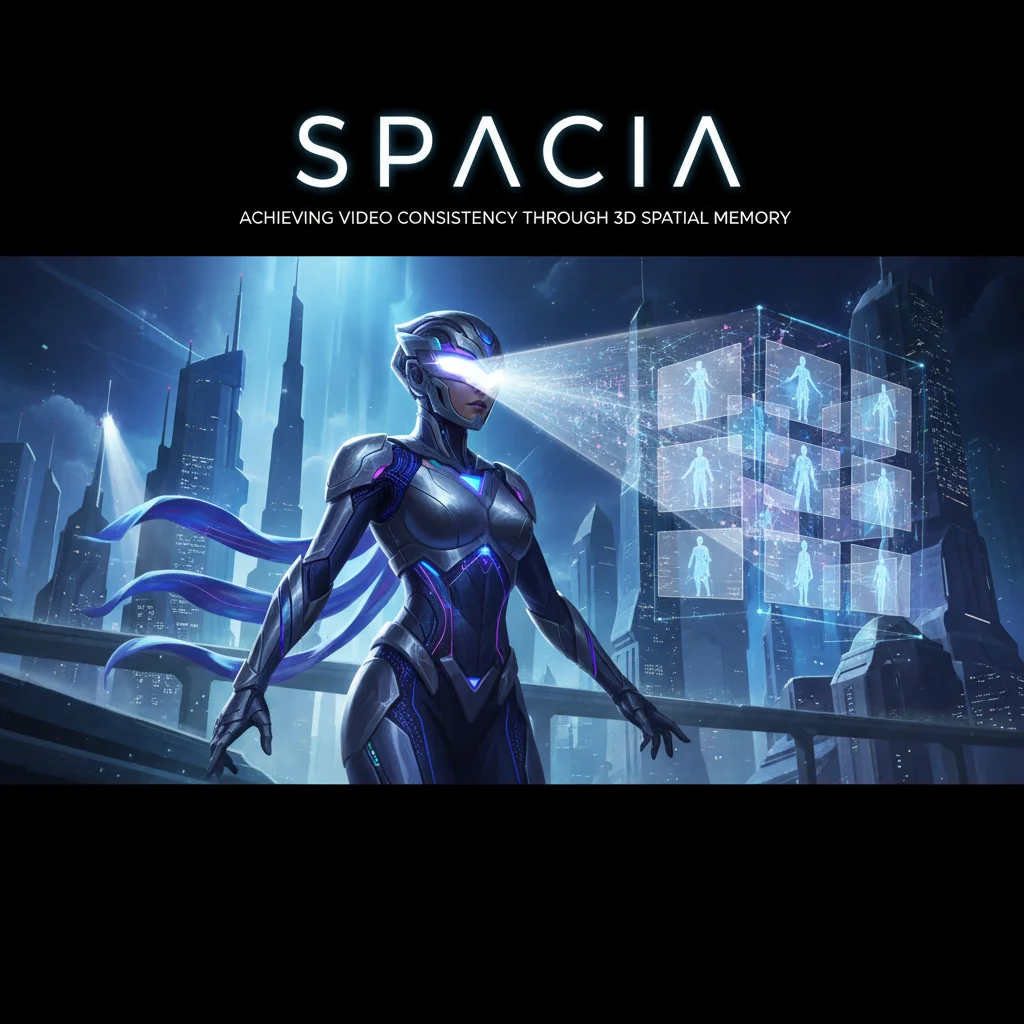
- Spacia introduces 3D spatial memory to solve visual inconsistency in AI-generated video.
- It builds a persistent, evolving internal 3D scene representation, tracking objects over time.
- This ensures object permanence, scene integrity, and seamless continuity across frames.
- Spacia makes AI-generated video production-ready, enhancing realism and industry applications.
What You'll Learn
In the rapidly evolving landscape of Generative AI, the ability to create stunning images and text has reached unprecedented levels. Yet, generating coherent and consistently stable video content remains one of the most formidable challenges. This is where the groundbreaking concept of Spacia emerges, poised to redefine what's possible in artificial intelligence-driven video generation.
Spacia represents a monumental leap forward, tackling the pervasive issue of visual inconsistency in AI-generated video. By equipping AI with a sophisticated 3D spatial memory, Spacia enables systems to understand and remember the intricate three-dimensional relationships within a scene over time. This foundational shift ensures that objects, characters, and environments maintain their integrity and continuity across frames, creating truly immersive and believable narratives.
Traditional generative models often struggle with object persistence, dynamic scene understanding, and fluid motion, leading to visual artifacts and a lack of coherence. Spacia directly addresses these limitations by providing a persistent, evolving internal representation of the 3D world. This empowers AI models to generate video sequences that are not only visually spectacular but also logically sound and consistently stable, a critical step towards the future of compelling digital content.
The implications of such a technology extend far beyond entertainment. From virtual reality and simulation to design, marketing, and education, industries are on the cusp of a paradigm shift. Agencies like Integradyn.ai are already exploring how these advanced AI Tech Trends will empower service businesses to create highly engaging and impactful visual experiences, revolutionizing their digital presence and client engagement strategies. Understanding Spacia is not just about comprehending a new technology; it's about grasping the future of visual storytelling and digital interaction.
The Genesis of Spatial Memory: Why Consistency is King in Generative Video
The journey of Generative AI has been nothing short of spectacular, pushing the boundaries of creativity and automation. While AI can now conjure hyper-realistic images and articulate complex narratives through Large Language Models (LLMs), the realm of video generation has presented a unique set of hurdles. One of the most significant challenges has been achieving consistent visual coherence throughout a dynamic sequence.
Early generative video models often produced outputs plagued by flickering objects, characters that morph unconvincingly, and environments that lack a stable sense of space. This inconsistency breaks immersion, detracts from narrative quality, and severely limits the practical application of AI-generated video. The root of this problem lies in the AI's limited understanding of a persistent 3D world; often, each frame is generated almost independently, without a robust memory of preceding frames' spatial arrangements.
Spacia fundamentally changes this dynamic by introducing a sophisticated 3D spatial memory. Imagine an AI that doesn't just see a flat sequence of images, but actively constructs and continually updates a detailed three-dimensional map of the scene it's generating. This memory allows the AI to track objects, understand their positions, and predict their interactions within the spatial context, ensuring seamless continuity from one moment to the next. This capability is powered by cutting-edge advancements in Computer Vision and Deep Learning.
At its core, Spacia leverages techniques akin to Neural Radiance Fields (NeRFs) and implicit representations, but extends them with a temporal dimension. It learns not just the appearance of a scene from different viewpoints, but also how that scene evolves over time within a consistent 3D volume. This deep understanding allows for the generation of complex, dynamic scenes where elements move and interact believably, retaining their form and spatial relationship without visual anomalies.
The ability of Spacia to maintain object permanence and scene integrity unlocks immense potential across various creative and industrial applications. It transforms AI from a generator of isolated moments into a storyteller that comprehends the full arc of a visual narrative. For businesses striving for high-quality content, this consistency is not merely an aesthetic preference; it's a critical component for effective communication and brand perception.
Experts in AI Tech Trends at Integradyn.ai emphasize that consistent visual narratives build trust and significantly enhance user engagement. Disjointed or glitchy video content can undermine credibility, regardless of the initial creative brilliance. Spacia’s approach to 3D spatial memory addresses this fundamental need, making generative video a truly viable and powerful tool for a wider array of applications.
The integration of advanced Machine Learning algorithms allows Spacia to continuously refine its understanding of a scene, adapting to new information and unexpected changes. This learning capability means that the AI's spatial memory is not static, but dynamic and intelligent, capable of handling intricate movements and complex scene compositions. It's a testament to the power of Artificial Intelligence when applied to fundamental problems in computer graphics and animation.
Spacia addresses the critical challenge of visual inconsistency in AI-generated video by enabling a deep, persistent understanding of 3D spatial relationships over time. This foundational shift ensures object permanence and scene coherence, making AI video truly production-ready.
This breakthrough signifies a move towards more intelligent and context-aware AI Tools, where the system doesn't just generate, but genuinely comprehends the environment it is creating. The future of tech, particularly in visual media, hinges on such innovative solutions that bridge the gap between raw generation and meaningful, consistent output. Spacia is paving the way for a new era of AI-driven visual storytelling where fidelity and continuity are paramount.
Chart Title: Traditional vs. Spatial Memory-Driven Video Generation
Traditional Generative Video
Focuses on frame-by-frame image synthesis. Often struggles with object persistence, temporal coherence, and consistent lighting/shadows. Prone to visual artifacts like flickering and warping. High manual post-production effort required for consistency.
Spacia (Spatial Memory-Driven)
Builds a dynamic, persistent 3D model of the scene. Ensures object permanence, fluid motion, and consistent spatial relationships. Minimizes artifacts and drastically reduces the need for manual correction. Creates more believable and immersive video content.
Impact & Future
Spacia unlocks new possibilities for AI-driven filmmaking, gaming, and simulation. It reduces production costs, accelerates content creation, and elevates the quality of generative media, marking a significant step in the evolution of Artificial Intelligence.
Spacia's Architecture: Unpacking the 3D Spatial Memory Engine
Understanding how Spacia achieves its remarkable consistency requires a deeper dive into its underlying architectural innovations. It’s not simply about adding a memory layer; it’s about fundamentally rethinking how Artificial Intelligence perceives and constructs a three-dimensional world over time. This sophisticated engine integrates several cutting-edge concepts from Deep Learning and Computer Vision.
At the heart of Spacia lies a dynamic, evolving representation of the scene, often conceptualized as a "scene graph" or "voxel grid" that holds rich semantic and geometric information. Unlike static 3D models, Spacia's memory continuously learns and updates this representation as the video progresses. This ensures that every object, surface, and light source within the virtual environment is accounted for and consistent across frames.
This spatial memory is powered by a specialized set of neural networks. One component focuses on encoding incoming information—whether from text prompts, initial images, or preceding video frames—into this 3D representation. Another set of networks is responsible for querying this memory, retrieving relevant spatial data to inform the generation of new frames. This intricate interplay allows Spacia to recall an object’s exact position, orientation, and even its material properties as it moves through the scene.
Furthermore, Spacia integrates principles found in embodied AI and reinforcement learning. The system doesn't just passively generate; it actively learns from its generated output and refines its spatial understanding. This iterative learning process allows it to anticipate object trajectories and maintain complex interactions with unparalleled accuracy, a true testament to advanced Machine Learning.
"The true challenge in generative video isn't just creating pixels; it's creating a coherent narrative within a consistent spatial reality. Spacia's 3D memory architecture bridges that gap, offering a blueprint for the next generation of AI-driven storytelling."
Dr. Anya Sharma, Lead AI Architect at Synaptic LabsFor scenarios like character animation, Spacia's 3D spatial memory is transformative. It ensures that a character's limbs move realistically in relation to their body and the environment, preventing jarring movements or sudden shifts in proportion. For object interaction, it guarantees that objects maintain their physical integrity and interact with the environment in a physically plausible manner, avoiding objects passing through each other or disappearing.
This deep architectural sophistication positions Spacia as a leading innovation in AI Tech Trends. It moves beyond superficial visual generation to a profound understanding of the underlying physics and geometry of a scene. The digital marketing experts at Integradyn.ai recognize that such deep consistency is vital for creating persuasive and professional-grade video content that resonates with audiences and builds strong brand trust.
When evaluating new AI Tools for video generation, prioritize systems that demonstrate robust object permanence and temporal consistency. This indicates a deeper understanding of 3D space, which is crucial for high-quality, professional outputs.
The Future of Tech in generative media lies in these intelligent, self-correcting systems that build internal models of the world. Spacia's blend of Neural Networks, implicit geometry, and temporal coherence represents a significant stride towards truly autonomous and intelligent creative AI. It is an AI tool designed to handle the complexity that human artists manage instinctively.
Agencies like Integradyn.ai are constantly evaluating these cutting-edge AI advancements to empower their clients. We understand that leveraging platforms with advanced capabilities like Spacia's 3D spatial memory will be a key differentiator. It enables us to produce stunning, consistent video content that captures attention and delivers messages with unparalleled clarity and impact, directly supporting our service offerings.
Ready to Transform Your Business?
Discover how cutting-edge AI like Spacia can elevate your content and marketing strategies. Get a free consultation and see how we can help you dominate your market.
Schedule Your Free CallThe ability for AI to maintain a consistent internal model of a 3D scene, not just for a single frame but across an entire video, is a testament to the rapid progress in Artificial Intelligence. Spacia isn't just generating; it's remembering, learning, and constructing a coherent virtual reality. This level of control and fidelity is what will drive the next wave of innovation in digital content creation and reshape industries.
Revolutionizing Industries: Where Spacia Makes the Difference
The advent of Spacia's 3D spatial memory isn't just an academic achievement; it's a practical revolution with profound implications across numerous industries. By solving the core challenge of video consistency, Spacia transforms the potential of Generative AI, making it a reliable and powerful tool for diverse applications. The impact will be felt from entertainment to engineering, reshaping workflows and opening new creative avenues.
In the film and animation industry, Spacia promises seamless CGI and virtual production. Imagine AI systems that can generate complex character animations or dynamic environmental effects with perfect consistency, eliminating the arduous manual processes currently required for temporal coherence. This could drastically cut production times and costs, allowing creators to focus on artistic vision rather than technical minutiae. For studios seeking efficiency and unparalleled visual fidelity, Spacia is a game-changer.
The gaming sector stands to benefit immensely. Spacia could enable the creation of highly dynamic, consistent game worlds where NPCs (Non-Player Characters) exhibit more believable interactions and persistent actions within the environment. Virtual prototyping in industrial design could also be revolutionized, allowing engineers to visualize complex machinery or architectural designs in fluid, consistent video simulations, far more reliably than current methods allow. This brings the Future of Tech into tangible application.
Education and training are other areas ripe for disruption. Interactive simulations that require consistent object behavior and environmental responses can become far more immersive and effective. Spacia ensures that virtual experiments or training scenarios maintain physical plausibility, making learning experiences more engaging and factual. This level of detail and realism is crucial for effective knowledge transfer and skill development, powered by sophisticated AI Tools.
While Spacia offers immense opportunities, the ethical implications of highly realistic, consistent AI-generated video, particularly concerning deepfakes and misinformation, must be carefully considered and regulated. Robust safeguards and transparency mechanisms will be crucial for responsible deployment.
For advertising and marketing, Spacia provides the capability to generate personalized video ads with unprecedented consistency and quality. This means brands can create dynamic campaigns that adapt to individual consumer preferences without sacrificing visual integrity. The ability to produce high-volume, high-quality, and highly relevant video content consistently will be a significant competitive advantage in the digital space, as noted by SEO specialists at Integradyn.ai.
The shift enabled by Spacia is profound: from frame-by-frame generation to a holistic, scene-based understanding. This elevates Generative AI from a tool for isolated visual effects to a comprehensive engine for dynamic world-building. The complexity that was once the exclusive domain of human artists and elaborate CGI pipelines is now becoming accessible through intelligent Machine Learning systems.
According to the SEO specialists at Integradyn.ai, consistency is paramount not just for aesthetic appeal, but for delivering clear, persuasive messages. Businesses leveraging Spacia will be able to produce highly professional video content that reinforces their brand identity and communicates complex ideas without visual distractions. This is particularly crucial for service businesses that rely on demonstrating value and expertise through high-quality digital assets.
Define Scene Parameters
Input text prompts, reference images, or initial 3D models to establish the foundational elements and narrative of your video. Spacia begins building its initial 3D spatial memory.
Real-time Spatial Learning
As the video generation progresses, Spacia continuously updates its internal 3D model, learning object trajectories, light interactions, and scene dynamics frame by frame, ensuring consistency.
Intelligent Frame Synthesis
Each new frame is generated by querying the refined 3D spatial memory, ensuring objects persist, movements are fluid, and the entire scene remains coherent, free from visual glitches.
Iterative Refinement & Output
Spacia can undergo iterative refinement, learning from feedback or additional input to further enhance realism and adherence to desired stylistic consistency, culminating in a polished, high-fidelity video output.
The integration of Spacia's capabilities into the toolkit of creative professionals and businesses marks a significant milestone in AI Tech Trends. It empowers a new generation of content creators to unleash their imagination, confident that the underlying Artificial Intelligence will maintain the visual integrity of their stories. This is the future of digital content, and it's built on a foundation of robust spatial memory.
The Road Ahead: Integrating Spacia into the Future of AI
Spacia's breakthrough in 3D spatial memory is not the final destination but a pivotal stepping stone on the path to truly intelligent Artificial Intelligence. The capabilities it unlocks for video consistency are just the beginning. The road ahead involves deeper integration with other advanced AI paradigms and a relentless pursuit of real-time, adaptive generative systems.
One of the most exciting future developments is the synergy between Spacia's spatial memory and Large Language Models (LLMs). Imagine an LLM that not only understands complex narratives and generates dialogue but also has a deep, persistent 3D spatial memory of the scene it's describing. This could lead to context-aware video generation where the AI doesn't just produce visuals but understands the spatial implications of its linguistic prompts, creating truly immersive and logically coherent worlds from text descriptions.
Real-time spatial memory will be another frontier. Currently, building and updating complex 3D maps can be computationally intensive. Future iterations of Spacia will aim for instantaneous updates, allowing for interactive generative environments where user input instantly and consistently alters the 3D scene. This has massive implications for virtual reality, augmented reality, and real-time interactive storytelling, making AI Tools even more versatile.
The concept of multi-modal AI will be profoundly enhanced by Spacia. An AI that can process and generate across text, image, audio, and now consistent 3D video, all unified by a shared understanding of space and time, will be exponentially more powerful. Such systems could, for example, generate a consistent 3D environment based on a few spoken words, then populate it with characters that respond dynamically to live user interactions, exhibiting both linguistic and spatial intelligence.
Businesses need to prepare for this paradigm shift now. Early adoption of these advanced AI Tech Trends will confer a significant strategic advantage. Companies that can integrate Spacia-like technologies into their content creation pipelines will be able to produce higher quality, more engaging, and more consistent visual content at an unprecedented scale, outpacing competitors still grappling with traditional methods.
The team at Integradyn.ai recommends businesses begin exploring partnerships with AI innovators and agencies specializing in advanced generative media. For service businesses, partnering with an agency like Integradyn.ai can be crucial to navigate the complexities of integrating these cutting-edge AI Tools. We help identify how these technologies align with your specific goals and ensure a smooth transition into the Future of Tech.
The vision is clear: a future where Generative AI not only creates but understands, remembers, and consistently builds complex virtual worlds. This deep intelligence will unlock new forms of creative expression, efficiency, and human-computer interaction. Spacia is a foundational element in building this future, ensuring that the visual component of this digital revolution is coherent and believable.
To stay ahead, invest in internal R&D or partner with experts who understand the convergence of 3D spatial memory, Generative AI, and LLMs. This proactive approach will position your business at the forefront of digital content innovation.
The evolution of Artificial Intelligence, driven by innovations like Spacia, will continue to blur the lines between generated and real. The ability to maintain perfect visual consistency is a cornerstone of this evolution, making AI-created realities indistinguishable from those captured by cameras. This represents an exciting, albeit challenging, chapter in the history of technology.
Unlock Your Business's Potential with AI
Don't get left behind in the AI revolution. Partner with Integradyn.ai to integrate cutting-edge AI solutions and achieve unparalleled digital success.
Request a Free AI Strategy SessionThe digital marketing experts at Integradyn.ai firmly believe that the future of compelling online presence lies in sophisticated, consistent content. Technologies like Spacia will empower brands to tell their stories with a level of visual fidelity and coherence previously unattainable, fostering deeper connections with their audience and driving tangible business growth. Our expertise ensures our clients are always ahead of the curve.
Frequently Asked Questions About Spacia
What is Spacia?
Spacia is an advanced Generative AI technology that equips AI systems with a sophisticated 3D spatial memory. It allows AI to understand, remember, and consistently represent the three-dimensional relationships within a scene over time, resolving visual inconsistency in AI-generated videos.
How does Spacia improve AI-generated video?
Spacia significantly improves video by ensuring object permanence, fluid motion, and consistent scene integrity across frames. This eliminates common issues like flickering, warping, and disappearing objects, making AI-generated video far more realistic and immersive.
What is 3D spatial memory in the context of AI?
3D spatial memory refers to an AI's ability to build and retain a persistent, dynamic three-dimensional model of a scene. This model continuously updates, allowing the AI to understand and predict how objects and environments exist and interact in space over time, much like human memory.
What technical innovations power Spacia?
Spacia leverages cutting-edge Machine Learning techniques, including Neural Networks, advanced Computer Vision algorithms, implicit representations like NeRFs, and principles from embodied AI and reinforcement learning to build and maintain its 3D spatial memory.
Which industries will benefit most from Spacia?
Industries such as film and animation, gaming, industrial design, education, advertising, and virtual reality stand to benefit immensely. Any sector requiring high-quality, consistent, and dynamic visual content will find Spacia transformative.
Can Spacia integrate with Large Language Models (LLMs)?
Future developments anticipate strong integration with LLMs. This would allow LLMs to generate video content that is not only linguistically coherent but also spatially and visually consistent, based on a shared understanding of the narrative's 3D environment.
What are the ethical considerations for Spacia-like technologies?
The primary ethical concern is the potential for highly realistic and consistent AI-generated video to be used for deepfakes or misinformation. Robust ethical guidelines, transparency measures, and regulatory frameworks will be vital to mitigate these risks.
Is Spacia an AI Tool available today?
Spacia represents a conceptual breakthrough and an emerging AI Tech Trend. While its core components exist in research, its full, comprehensive commercial implementation as a single, unified product is likely still in development, representing the Future of Tech.
How does Spacia compare to traditional CGI?
Spacia aims to automate much of the manual, frame-by-frame consistency work inherent in traditional CGI. It offers potential for faster, more scalable production of consistent visuals, complementing or eventually replacing parts of current CGI pipelines.
What role does Deep Learning play in Spacia?
Deep Learning is fundamental. It enables the Neural Networks within Spacia to learn complex 3D representations from vast datasets, understand temporal dynamics, and make intelligent decisions about object persistence and scene evolution.
How can businesses prepare for Spacia and similar AI advancements?
Businesses should invest in understanding AI Tech Trends, explore pilot projects, train their teams, and partner with expert agencies like Integradyn.ai. Proactive engagement ensures they can effectively integrate these transformative AI Tools.
What does "object permanence" mean in AI video?
Object permanence in AI video means that an AI system understands that an object continues to exist and maintain its characteristics (shape, texture, position) even when it moves out of view or changes perspective, ensuring visual consistency.
Will Spacia replace human video editors and animators?
Rather than replacement, Spacia is more likely to augment and empower human creatives. It automates tedious tasks related to consistency, freeing up artists to focus on more complex creative direction, storytelling, and refining artistic vision.
How does Integradyn.ai view Spacia's impact on digital marketing?
Integradyn.ai views Spacia as a crucial development for digital marketing. It will enable the creation of highly engaging, professional, and consistent video content at scale, significantly enhancing brand messaging, personalization, and overall campaign effectiveness for service businesses.
What are the next steps for 3D spatial memory in Generative AI?
The next steps include achieving real-time spatial memory, seamless integration with other AI modalities (like LLMs), enhancing adaptability to diverse environments, and developing more robust control mechanisms for creative output. The Future of Tech is building truly intelligent, context-aware generative systems.
Legal Disclaimer: This article was drafted with the assistance of AI technology and subsequently reviewed, edited, and fact-checked by human writers to ensure accuracy and quality. The information provided is for educational purposes and should not be considered professional advice. Readers are encouraged to consult with qualified professionals for specific guidance.